
ISO 19650 Guidance 0: The case for information management
Introduction
This guidance document (guidance 0) sits within the overall guidance framework. It provides the high-level case for information management and is relevant to any organisation involved in the procurement, design, construction, operation or maintenance of a built asset. Detailed, technical guidance supporting the implementation of information management is provided through documents 1 – 4 and A-F.
1.0 Digital transformation
There is a need to harmonise, digitise, and rationalise the way we work. Therefore, digital transformation of the built environment sector requires new practices for whole life information management. Having standardised, good quality, structured information with proportionate security controls means it can be appropriately exchanged, interrogated, and reused for different purposes across a range of technologies. In response to the low levels of productivity found in the global built environment sector, the UK Government’s Made Smarter Review sets out a vision and plan for creating an environment where digital technologies will lead the development of the UK economy. A root cause of this low productivity is the high transactional cost of information exchange and lack of transparency across the sector. There is a movement within both public and private sector clients to develop innovative practices that improve the performance of all industries within the built environment. These practices include the production of object-based information models and simulations of physical systems and assets, which will help manage risks and provide greater assurance in key decision making. This approach will enable greater automation of standard processes during design and construction and into operations and maintenance. Intelligent data models (digital twins) will be able to update in near-real time, using information from sensors and networked devices, and interacting and exchanging information with other systems through the Internet of Things. This will optimize performance, improve health and safety and end-user experience, and in doing so, will enable smart communities to become a reality to serve society. To achieve this requires more than new technologies. It needs new operating models that move from transactional ways of working to incentivized collaboration across the built environment, plus new standards, methods, policies and capabilities. Developing new collaborative and integrated business models and exploring the production of a national digital twin or a single unified information framework will enable the sector to capitalize on the digital transformation agenda. Implementation of information management is no longer a question of ‘if’; it is now a fundamental part of delivering world-class social and economic infrastructure. Digital transformation can be achieved through gradual yet sustained progress over a period of time. It is possible to break the overall objective down into smaller steps incorporating lessons learned as these are rolled-out.
2.0 Why information management is important
Information management is the process by which organisations, with appropriate security controls, specify, procure, assure, store, present, and exploit information to perform core business. Introducing information management successfully into any organisation requires three overlapping key components: people, process and technology. With these three components in place, the opportunity to innovate and automate at scale can be realised. ISO 19650 Guidance 0: The case for information management 2
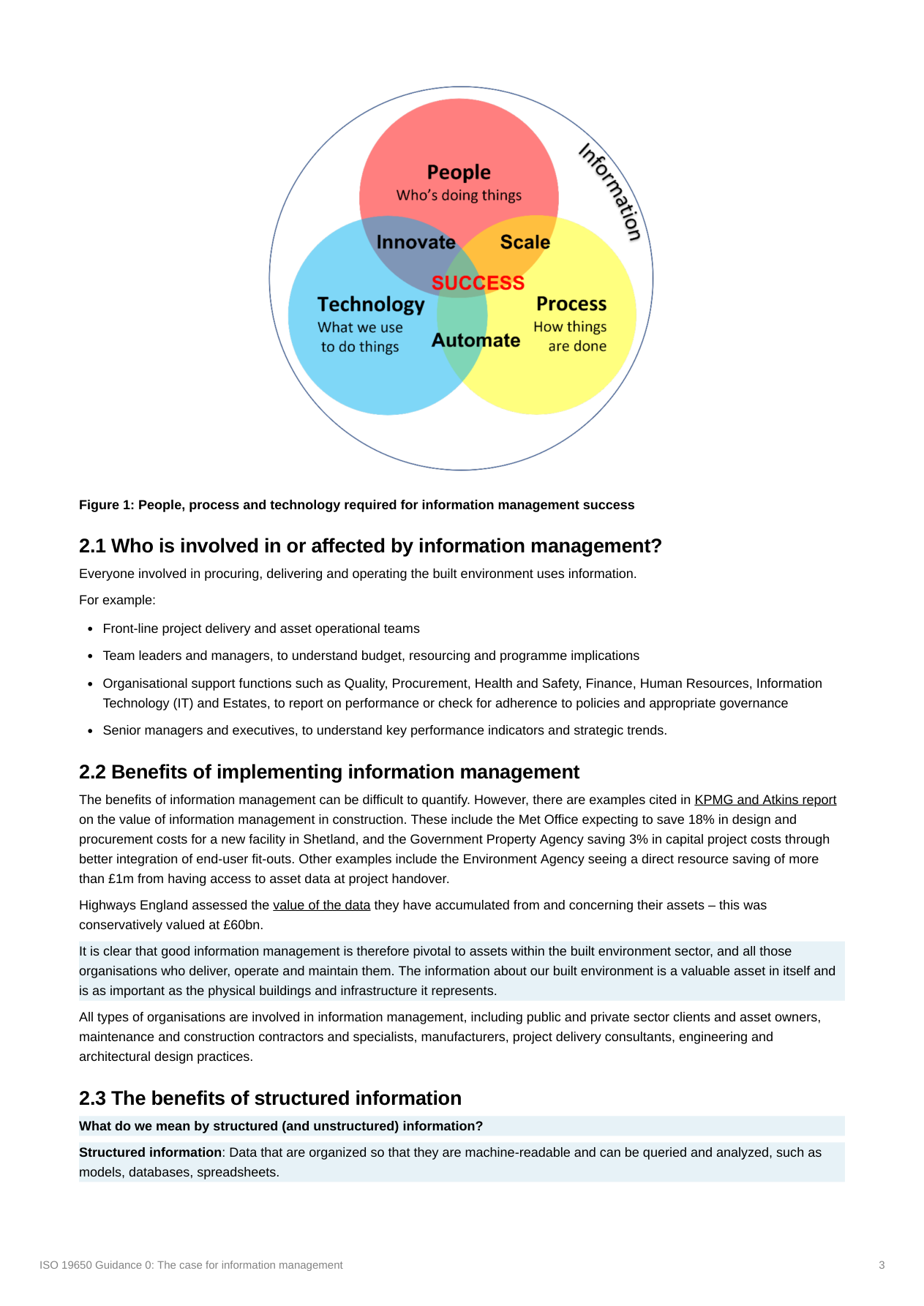
Figure 1: People, process and technology required for information management success
2.1 Who is involved in or affected by information management?
Everyone involved in procuring, delivering and operating the built environment uses information. For example: Front-line project delivery and asset operational teams Team leaders and managers, to understand budget, resourcing and programme implications Organisational support functions such as Quality, Procurement, Health and Safety, Finance, Human Resources, Information Technology (IT) and Estates, to report on performance or check for adherence to policies and appropriate governance Senior managers and executives, to understand key performance indicators and strategic trends.
2.2 Benefits of implementing information management
The benefits of information management can be difficult to quantify. However, there are examples cited in KPMG and Atkins report on the value of information management in construction. These include the Met Office expecting to save 18% in design and procurement costs for a new facility in Shetland, and the Government Property Agency saving 3% in capital project costs through better integration of end-user fit-outs. Other examples include the Environment Agency seeing a direct resource saving of more than £1m from having access to asset data at project handover. Highways England assessed the value of the data they have accumulated from and concerning their assets – this was conservatively valued at £60bn. It is clear that good information management is therefore pivotal to assets within the built environment sector, and all those organisations who deliver, operate and maintain them. The information about our built environment is a valuable asset in itself and is as important as the physical buildings and infrastructure it represents. All types of organisations are involved in information management, including public and private sector clients and asset owners, maintenance and construction contractors and specialists, manufacturers, project delivery consultants, engineering and architectural design practices.
2.3 The benefits of structured information
What do we mean by structured (and unstructured) information? Structured information: Data that are organized so that they are machine-readable and can be queried and analyzed, such as models, databases, spreadsheets. ISO 19650 Guidance 0: The case for information management 3
Unstructured information: Typically, text-heavy and not organized in a pre-defined manner that needs human interpretation, such as drawings, documents, images, photos, videos. There are efficiency benefits from capturing data once and transforming it into information and reusing it many times, for multiple purposes. But this doesn’t just happen automatically. A lot of thought and preparation is needed to make sure this efficiency is enabled by the appropriate collection methods and by how information is structured and stored. Having information in a structure means that some automatic checking can be done both when information is generated and when it is delivered. This means an organisation can be sure about the quality of the information before it is used for analysis and subsequent decision-making. One of the main advantages of structured information is the speed with which it can be searched, grouped, processed and analyzed. Using computers and IT systems to do what they are good at, such as gathering, storing and aggregating structured information quickly, frees up people
2.4 Information led decision making
Information is used to make decisions across all types of project and asset operations. To achieve the best outcomes, information needs to be the right quality for the decisions that need to be made. This will result in decisions that are based on evidence not intuition. In other words, information needs to be sufficiently structured, accurate, detailed and timely so that it can be exploited fully. A digital audit trail will show when decisions have been made and the information they have been based on. This then provides the trustworthiness that is required.
2.5 Cost of implementing information management
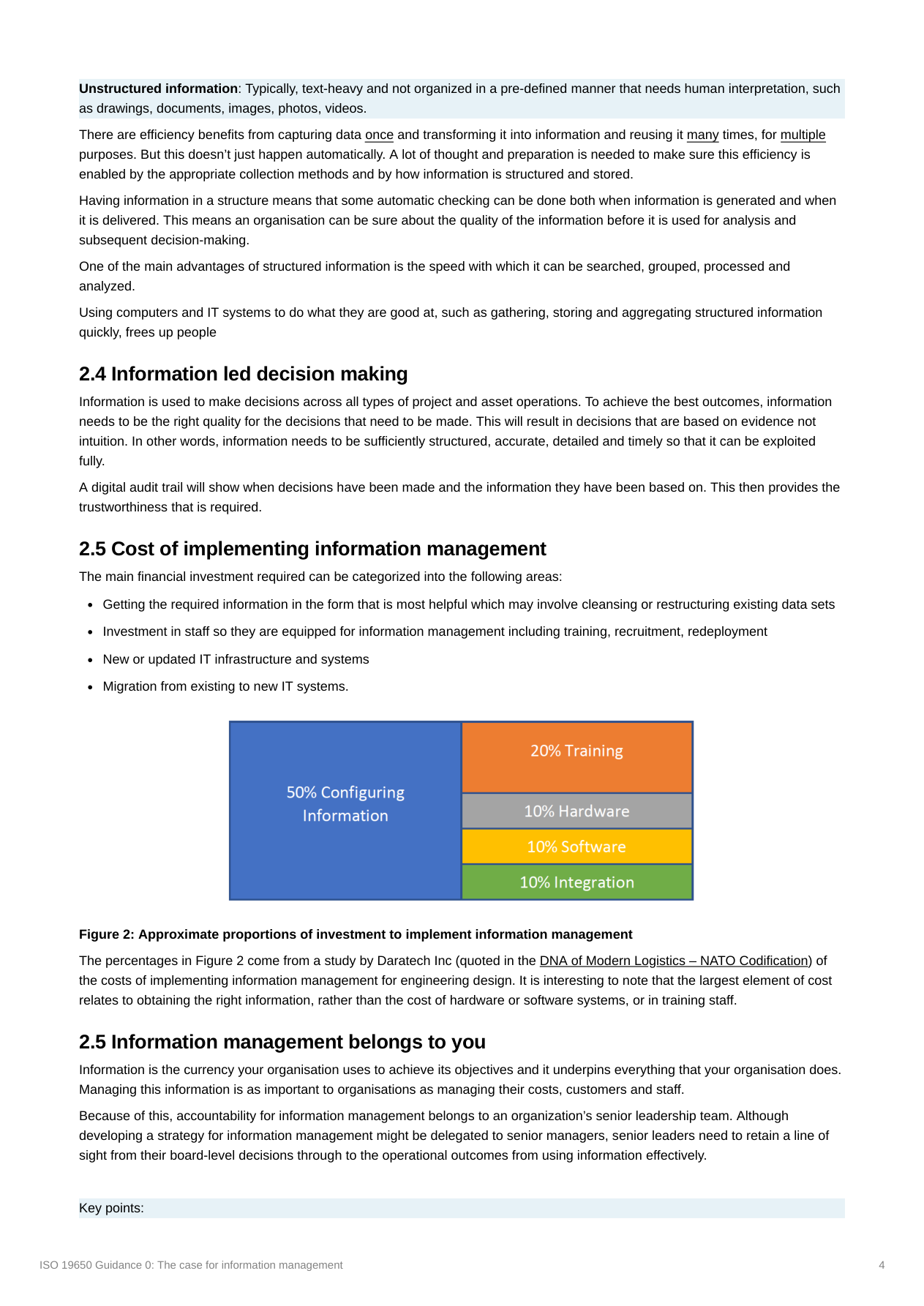
The main financial investment required can be categorized into the following areas: Getting the required information in the form that is most helpful which may involve cleansing or restructuring existing data sets Investment in staff so they are equipped for information management including training, recruitment, redeployment New or updated IT infrastructure and systems Migration from existing to new IT systems. Figure 2: Approximate proportions of investment to implement information management The percentages in Figure 2 come from a study by Daratech Inc (quoted in the DNA of Modern Logistics – NATO Codification) of the costs of implementing information management for engineering design. It is interesting to note that the largest element of cost relates to obtaining the right information, rather than the cost of hardware or software systems, or in training staff.
2.5 Information management belongs to you
Information is the currency your organisation uses to achieve its objectives and it underpins everything that your organisation does. Managing this information is as important to organisations as managing their costs, customers and staff. Because of this, accountability for information management belongs to an organization’s senior leadership team. Although developing a strategy for information management might be delegated to senior managers, senior leaders need to retain a line of sight from their board-level decisions through to the operational outcomes from using information effectively. Key points: ISO 19650 Guidance 0: The case for information management 4
Information is your organization’s currency It is used to underpin everything your organisation achieves Boards and leadership teams set the vision Senior managers develop the strategy to implement information management Everyone has some form of responsibility for information management
3.0 UK history and motivation
The 2011 BIM Working Group Strategy Paper sets out a hypothesis and several tests to develop a strategy for the widespread introduction of BIM with increasing maturity: ‘Government as a client can derive significant improvements in cost, value and carbon performance through the use of open sharable asset information’. This was accepted and published as the BIM mandate in the Government Construction Strategy 2011, commonly referred to as ‘BIM Level 2’. Since 2011, central Government departments within the Home Nations (England, Scotland, Wales and Northern Ireland) and various private sector clients have tested this approach to information management. These early adopter projects demonstrated a significant value proposition of purpose driven, structured, verified and validated information models and their managed exchanges in a collaborative and secure environment. Some case studies supporting information management can be found here. Digital transformation of the UK built environment industry was a cornerstone of the Government Construction Strategy 2016–2020 which sought to ‘embed and increase the use of digital technology’. Pivotal to this shift was adoption of building information modelling to change the way the UK designed, built, operated and integrated its built infrastructure. To bring the UK BIM mandate up-to-date, in September 2021 the Infrastructure and Projects Authority published a new Information Management Mandate. This can be found in Annex B of the Transforming Infrastructure Performance: Roadmap to 2030. This refreshed mandate requires public sector clients to use the UK BIM Framework across their projects and operational assets. This incorporates the ISO 19650 series of standards along with some related British Standards [and guidance/tools] and replaces what was previously known as ‘BIM Level 2’. Nothing in this guidance constitutes legal advice or gives rise to a solicitor/client relationship. Specialist legal advice should be taken in relation to specific circumstances. The contents of this guidance are for general information purposes only. Permission to reproduce extracts from the ISO 19650 series is granted by BSI Standards Limited (BSI). No other use of this material is permitted. British Standards can be obtained in PDF or hard copy formats from the BSI online shop: http://www.bsigroup.com/Shop or by contacting BSI Customer Services for hard copies only: Tel: +44 (0)20 8996 9001, Email: cservices@bsigroup.com Any data or analysis from this guidance must be reported accurately and not used in a misleading context. If using any information from this report, then its source and date of publication must be acknowledged. © COPYRIGHT 2023 the Editors, Authors and Contributors named in the Acknowledgements. Rrd01UVTROeUlzSW5kdmNtdHpjR0ZqWlZSeVlXTnJaWEpKWkNJNkltMU1ha0ZXVWtGd04zZE5iemhzTjBoMk1IRXpJbjA9 ISO 19650 Guidance 0: The case for information management 5