
Guidance E: Tendering and appointments
Nội dung
- 2 | Guidance Part E Edition 2 - February 2021
- 3 | Guidance Part E Edition 2 - February 2021
- Message from the
- 4 | Guidance Part E Edition 2 - February 2021
- Acknowledgments
- 5 | Guidance Part E Edition 2 - February 2021
- About BS EN ISO 19650
- Forewords in ISO 19650 Parts 1 and 2, and a
- 6 | Guidance Part E Edition 2 - February 2021
- About this guidance document
- 7 | Guidance Part E Edition 2 - February 2021
- 8 | Guidance Part E Edition 2 - February 2021
- Abbreviations and acronyms
- 9 | Guidance Part E Edition 2 - February 2021
- 1 The client in respect of ISO 19650-2 and asset owner, asset operator or facility manager for ISO 19650-3
- 10 | Guidance Part E Edition 2 - February 2021
- 2 Or Request to provide a service information
- 11 | Guidance Part E Edition 2 - February 2021
- 12 | Guidance Part E Edition 2 - February 2021
- 13 | Guidance Part E Edition 2 - February 2021
- 14 | Guidance Part E Edition 2 - February 2021
- 15 | Guidance Part E Edition 2 - February 2021
- 16 | Guidance Part E Edition 2 - February 2021
- 17 | Guidance Part E Edition 2 - February 2021
- 18 | Guidance Part E Edition 2 - February 2021
- 19 | Guidance Part E Edition 2 - February 2021
- 20 | Guidance Part E Edition 2 - February 2021
- 21 | Guidance Part E Edition 2 - February 2021
- 22 | Guidance Part E Edition 2 - February 2021
- 23 | Guidance Part E Edition 2 - February 2021
- 24 | Guidance Part E Edition 2 - February 2021
- 2 clause 5.1.6 a) to support the tender and lead appointed party considers developing
- 25 | Guidance Part E Edition 2 - February 2021
- 26 | Guidance Part E Edition 2 - February 2021
- 27 | Guidance Part E Edition 2 - February 2021
- 28 | Guidance Part E Edition 2 - February 2021
- 9 The BEP is developed by the lead appointed
- 9 If you are a lead appointed party, develop
- 9 If you are a (prospective) appointed party
- 9 Consider the points a) to g) in ISO 19650-2
- 9 Review and confirm the BEP during the
- 9 Keep your delivery team’s BEP up to date
- 29 | Guidance Part E Edition 2 - February 2021
Information management according to BS EN ISO 19650 Guidance Part E Tendering and appointments Edition 2 Published by
2 | Guidance Part E Edition 2 - February 2021
Tendering and appointments Editions Edition 1 September 2020 First release as Guidance E. Note this guidance text first appeared in ISO 19650 Part 2 guidance edition 3 Edition 2 February 2021 Update to include guidance about the UK BIM Framework Information Protocol Template and the information standard Nothing in this guidance constitutes legal advice or gives rise to a solicitor/client relationship. Specialist legal advice should be taken in relation to specific circumstances. The contents of this guidance are for general information purposes only. British Standards can be obtained in PDF or hard copy formats from the BSI online shop: http://www.bsigroup.com/Shop or by contacting BSI Customer Services for hard copies only: Tel: +44 (0)20 8996 9001, Email: cservices@bsigroup.com Any data or analysis from this guidance must be reported accurately and not used in a misleading context. If using any information from this report, then its source and date of publication must be acknowledged. © COPYRIGHT 2021 the Editors, Authors and Contributors named herein
3 | Guidance Part E Edition 2 - February 2021
Tendering and appointments
Message from the
UK BIM Alliance Chair Author: Dr Anne Kemp OBE Chair - UK BIM Alliance The UK BIM Framework provides the be the “end in mind” and consideration from fundamental step towards digital an organizational, whole life perspective. transformation of the UK’s built environment This then informs the detailed requirements industry. The Framework is based on the right down to appointment level. ISO 19650 series, which first developed out of the UK’s former BIM Level 2, but The work behind developing this Guidance incorporates and anticipates global and has been considerable. I would like to future digital perspectives. thank Sarah Davidson and David Churcher for their tireless commitment in continuing The UK BIM Framework embraces and to bring this work together – I so enjoy assists in the implementation of the working with you both. Secondly, I would standards for managing information for the like to thank the many authors who have whole life of assets of the built environment. contributed so generously to the writing The Framework anticipates the potential for of the Guidance – and been so patient integration across portfolios. The Framework in the criticisms and changes that have provides extensive Guidance which continues been required of them. Finally, I would to be developed, including the addition of like to thank the many people who have supplementary tools and materials to enable spared time to review and feedback on the a firm basis for the evolving National Digital Guidance – the Focus Groups in particular, Twin Programme. but also those who have contacted us separately. Without this feedback we would This Guidance has been developed to help not be able to incorporate the wide-ranging industry to implement the concepts and experience and testing which is occurring principles of the ISO 19650 series upon which around the industry. the UK BIM Framework is based. It has been continually updated to keep track of We welcome your continued feedback and the publication of the different parts of ISO shared experiences. You can provide this via 19650, and to reflect lessons learnt as further guidancefeedback@ukbimframework.org. experience is gained in its implementation. The key parts of ISO 19650 are now all in place, allowing us to realize information management throughout the whole life of built environment assets. It provides for traditional ways of working entailing exchange of information via files, but also caters for shifts towards data exchange. The key is being specific about what information is required and how it is to be delivered. This needs forethought around what should
4 | Guidance Part E Edition 2 - February 2021
Tendering and appointments
Acknowledgments
This guidance represents the collaborative efforts of the following people and organizations Editors David Churcher Hitherwood Consulting Ltd Sarah Davidson University of Nottingham Anne Kemp Atkins Authors Andrew Croft Beale & Company Solicitors LLP Sarah Davidson The University of Nottingham Jack Dearlove ISG Simon Lewis Womble Bond Dickinson Dan Rossiter British Standards Institution May Winfield Buro Happold Contributors John Ford Galliford Try Sarah Fox 500 Words Ltd Mo Shana’a Morta Production Centre for Digital Built Britain
5 | Guidance Part E Edition 2 - February 2021
Tendering and appointments
About BS EN ISO 19650
The BS EN ISO 19650 series of standards Standards within the ISO 19650 series are (herein after referred to as the ISO 19650 available at www.bsigroup.com. series) is an international standard of good Visit www.ukbimframework.org to see how the practice. It defines information management ISO 19650 standards plus other standards principles and requirements within a within the UK BIM Framework map to the broader context of digital transformation design, build, operate and integrate process in the disciplines and sectors of the built environment (including construction and asset management industries). Its implementation in the UK is supported by UK National
Forewords in ISO 19650 Parts 1 and 2, and a
UK National Annex in ISO 19650 Part 2. The ISO 19650 series replaces some of the existing British Standards and Publicly Available Specifications relating to information management using building information modelling (BIM). It is part of a landscape, or ecosystem, of national and international standards supporting information management processes and technical solutions. It considers all information whether it is a construction programme, a record of a meeting, a geometrical model or a contract administration certificate. Building information modelling (BIM) plays a key part in the management of information because it provides a methodology that helps us to structure information so that technology can process it. Structuring information using industry standards helps to improve interoperability. This means that information can be joinedup by both people and technology, which then enables us to extract more valuable knowledge from it. Using the same information structures throughout industry generates consistency, repetition and predictability. This brings real efficiency gains for businesses and provides the data architecture for the connected future..
6 | Guidance Part E Edition 2 - February 2021
Tendering and appointments
About this guidance document
(executive summary) The guidance framework supports the UK Guidance E is written to support the implementation of the ISO 19650 series. implementation of each published ISO 19650 This guidance document (guidance E) sits standard. within an overall guidance framework as shown in Figure 1: ISO 19650 Guidance Part 1 Concepts ISO 19650 ISO 19650 ISO 19650 ISO 19650 Guidance Part 2 Guidance Part 3 Guidance Part 4 Guidance Part 5 Delivery phase Operational phase (To be confirmed) (To be confirmed) ISO 19650 ISO 19650 ISO 19650 ISO 19650 ISO 19650 ISO 19650 Guidance A Guidance B Guidance C Guidance D Guidance E Guidance F The Open data, Facilitating the Developing Tendering and Information information buildingSMART CDE (workflow information appointments delivery management and COBie and technical requirements planning function & solutions) resources Figure 1: ISO 19650 guidance framework
7 | Guidance Part E Edition 2 - February 2021
Tendering and appointments Who is this guidance written for? Key takeaways This guidance is for individuals and teams • The UK BIM Framework Information involved in the tendering and appointment Protocol Template provides an example of process on behalf of the appointing party, what could be included in an information lead appointed party and the appointed protocol to be used when conforming to parties. ISO 19650-2 and/or ISO 19650-5. • A properly completed information protocol Who is this guidance of particular interest should be included in all appointments to and why? (between separate legal entities) where there is a requirement to manage or This guidance is of interest to the appointing produce information. party, the lead appointed party and each of the appointed parties. It explains about • Without a correctly incorporated the UK BIM Framework Information Protocol information protocol there is no clear Template, the information standard and the obligation on either party entering into an BIM execution plan (BEP). This guidance will appointment to comply with ISO 19650-2 or be updated in due course to consider other ISO 19650-3. tender and appointment resources referred to • The purpose of an information standard in the ISO 19650 series. is to provide the standards against which the information should be produced and subsequently maintained. It is established by the appointing party (client) and like an information protocol, should be included in all appointments where there is a requirement to manage or produce information. • The BEP supports the tender, appointment and information delivery activities by providing evidence to the appointing party that the prospective delivery team can manage project information in line with the information requirements. • The BEP presents one of the tools that the appointed delivery team will use to produce, manage and exchange project information during the appointment alongside other resources. • In the process of finalizing the appointment for the lead appointed party, the BEP is revisited and updated to ensure it supports production of the detailed responsibility matrix and master information delivery plan. As with all guidance supporting the UK BIM Framework, we invite comment and feedback on this guidance E at guidancefeedback@ukbimframework.org
8 | Guidance Part E Edition 2 - February 2021
Tendering and appointments
Abbreviations and acronyms
This guidance includes a number of abbreviations and acronyms as set out in Table 1. Table 1: Abbreviations and acronyms Abbreviation or acronym Term BEP BIM execution plan BIM Building information modelling EIR Exchange information requirements MIDP Master information delivery plan TIDP Task information delivery plan
9 | Guidance Part E Edition 2 - February 2021
Tendering and appointments
1.0 About the information protocol
Author: Andrew Croft Beale & Company Solicitors LLP Sarah Davidson The University of Nottingham Simon Lewis Womble Bond Dickinson May Winfield Buro Happold
1.1 Introduction
An information protocol is one of the The UK BIM Framework Information Protocol resources that supports the implementation Template provides an example of what could of information management using building be included in an information protocol to be information modelling (BIM). Both ISO used when conforming to ISO 19650-2 and/ 19650-2 and ISO 19650-3 require that the or ISO 19650-5 (as applicable) for projects appointing party1 produces an information and their appointments to which English law protocol and that it forms part of tender applies. It is not prescriptive but it provides and appointment documents The UK BIM a useful starting point for an Information Framework Information Protocol Template is Protocol. An Information Protocol Template for use in compliance with ISO 19650-2 only, to support conformance with ISO 19650-3 i.e. at delivery phase; an Information Protocol is under review and it is important to note template for use in compliance with ISO19650- that the Information Protocol Template as 3, (i.e. the maintenance and operational currently drafted does not conform with ISO phase) is under review. ISO 19650-2 refers 19650-3. This guidance however does refer to the information protocol as the project’s to ISO 19650-3 where applicable to provide information protocol and ISO 19650-3 refers an overview of the approach taken by the to it as the asset information protocol. Information Protocol Template. Neither the UK BIM Framework Information Although ISO 19650-2 and ISO 19650-3 Protocol Template nor this guidance amount address different parts of the asset life-cycle to legal advice and you should ensure you and use a different prefix for the information always take appropriate professional advice protocol, the purpose of it is the same; that to assist all parties to work in a way which is to set out the rights and obligations of the reflects ISO 19650-2 and ISO 19650-5 (as two parties entering into an appointment that applicable). requires the management or production of information. ISO 19650-5 does not refer to an information protocol, however it does require that there is provision in all appointment documentation for the requirements set out in ISO 19650-5 clause 9.2. These obligations therefore do need to be considered.
1 The client in respect of ISO 19650-2 and asset owner, asset operator or facility manager for ISO 19650-3
10 | Guidance Part E Edition 2 - February 2021
Tendering and appointments
1.2 Production of an information
protocol: principles An information protocol should be established by the appointing party at a project level (ISO 19650-2) or an asset/portfolio management level (for ISO 19650-3). It should be included in invitation to tender information2 and then in appointment documentation for every third party (where the third party is a separate legal entity) that will manage or produce information as part of their activities within that appointment. The relevant ISO 19650 clauses requiring these actions are set out in Table 2: Table 2: ISO 19650 requirements for the information protocol: Activity 19650-2 clause 19650-3 clause Responsibility Establish the information protocol 5.1.8 5.1.13 Appointing party Include the information protocol in 5.2.4 5.2.5 Appointing party the invitation to tender or request for a service Include the information protocol in 5.4.6 5.4.6 Appointing party lead appointed party’s appointment documents Include the information protocol 5.4.7 5.4.7 Lead appointed in appointed party’s appointment party documents
2 Or Request to provide a service information
11 | Guidance Part E Edition 2 - February 2021
Tendering and appointments
1.3 Inclusion of an information
protocol in appointments As noted in the Introduction, ISO19650-2 and ISO 19650-3 envisage that an information protocol is included in completed appointment documents for each lead appointed party and their appointed parties. See Figure 2 for a delivery phase example. Appointing party (the client) Appointment including an Lead appointed information protocol party (for example for construction) Appointment including an information protocol Appointed party (for example the steelwork sub-contractor) Figure 2: Simple party/appointment relationship; delivery phase example For different and more complex appointment arrangements please refer to ISO 19650 guidance Parts 2 and 3. The ISO 19650 series only refers to the tender package for the lead appointed party (in Figure 2, the tender package for the lead appointed party for construction). However, an information protocol will need to be included in any tender package (in Figure 2, the steelwork package) so that every party invited to submit a tender is aware of their obligations should they be appointed. Similarly, the ISO 19650 series does not specifically consider the tender or appointment of sub-parties, but they too will need to enter into an information protocol where they are managing or producing information as part of their scope of works.
12 | Guidance Part E Edition 2 - February 2021
Tendering and appointments
1.4 Information Protocol Template »
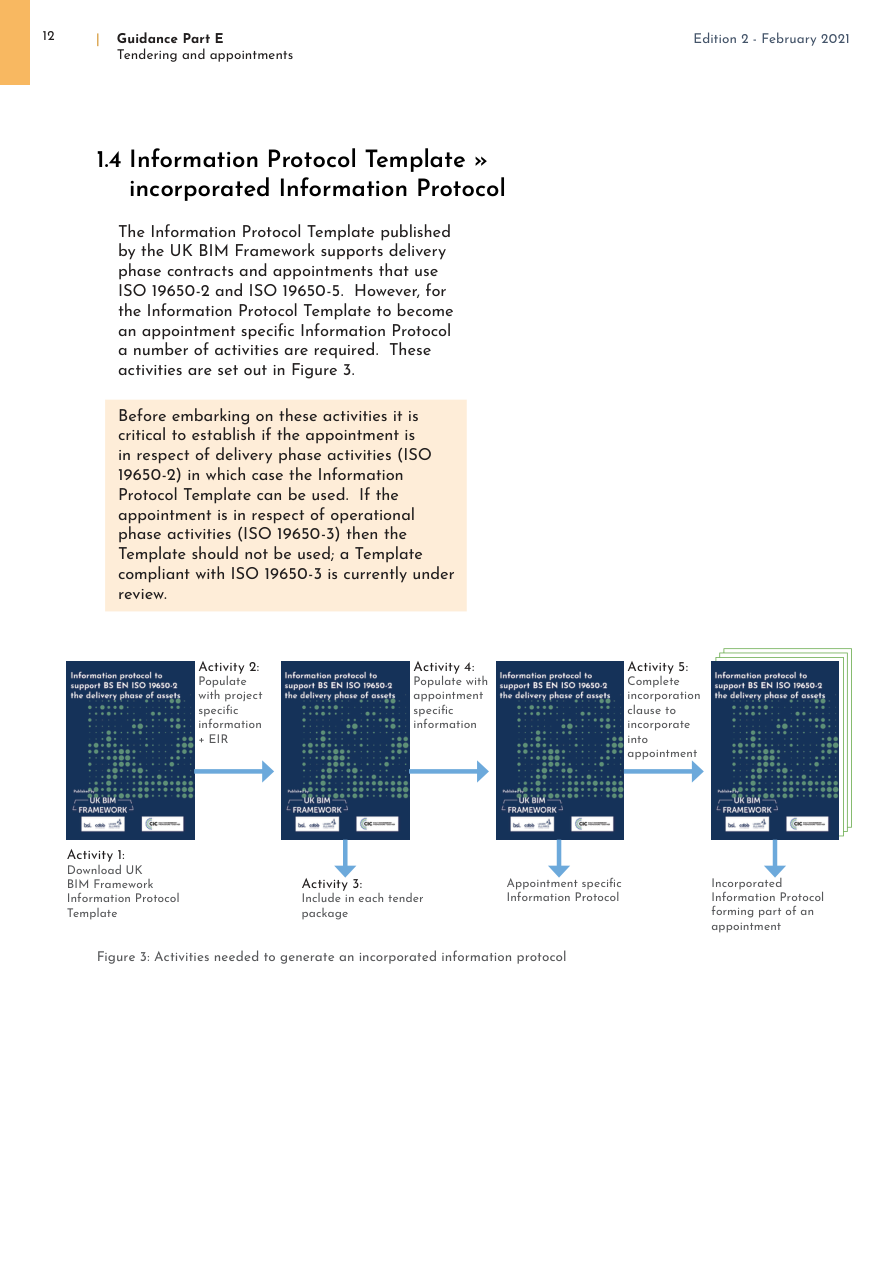
incorporated Information Protocol The Information Protocol Template published by the UK BIM Framework supports delivery phase contracts and appointments that use ISO 19650-2 and ISO 19650-5. However, for the Information Protocol Template to become an appointment specific Information Protocol a number of activities are required. These activities are set out in Figure 3. Before embarking on these activities it is critical to establish if the appointment is in respect of delivery phase activities (ISO 19650-2) in which case the Information Protocol Template can be used. If the appointment is in respect of operational phase activities (ISO 19650-3) then the Template should not be used; a Template compliant with ISO 19650-3 is currently under review. Activity 2: Activity 4: Activity 5: Populate Populate with Complete with project appointment incorporation specific specific clause to information information incorporate + EIR into appointment Activity 1: Download UK BIM Framework Activity 3: Appointment specific Incorporated Information Protocol Include in each tender Information Protocol Information Protocol Template package forming part of an appointment Figure 3: Activities needed to generate an incorporated information protocol
13 | Guidance Part E Edition 2 - February 2021
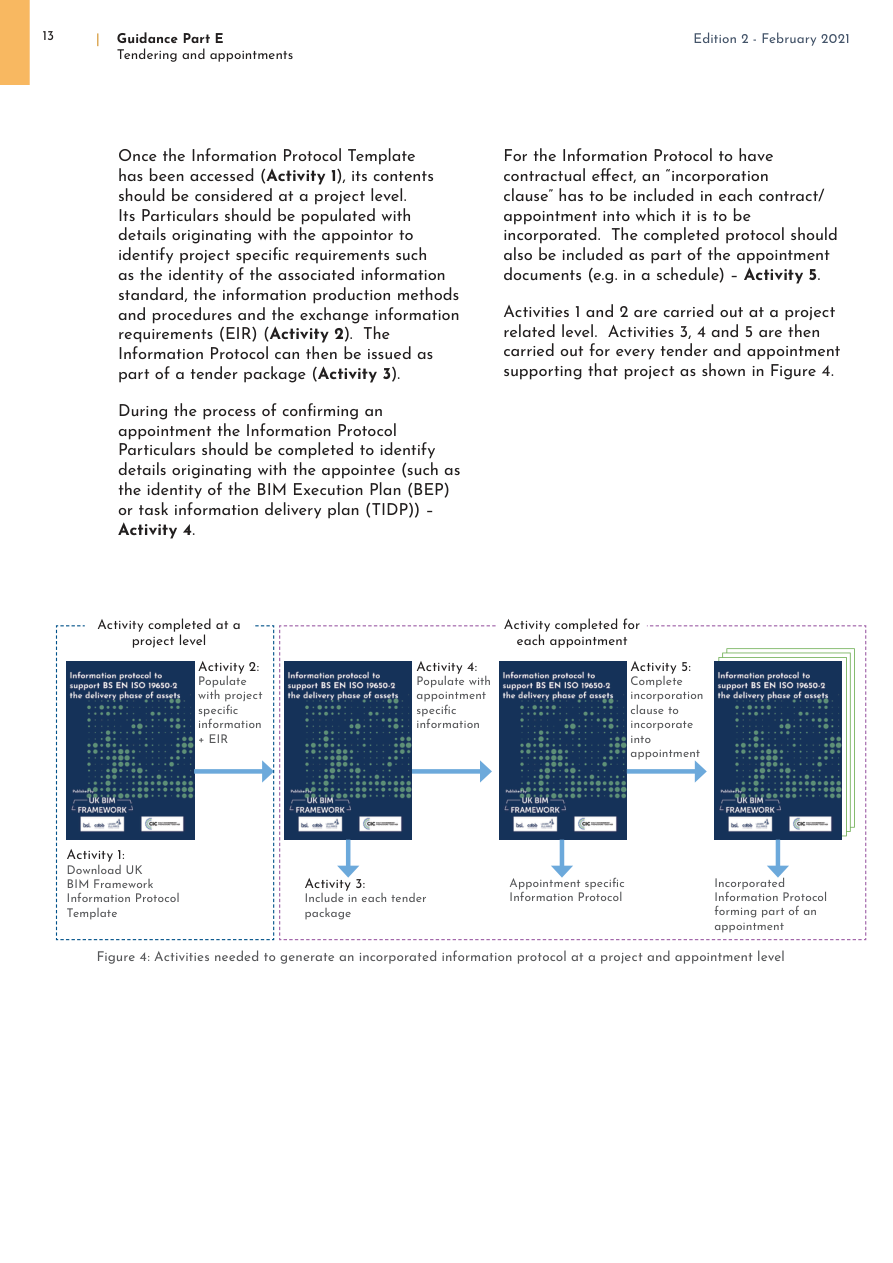
Tendering and appointments Once the Information Protocol Template For the Information Protocol to have has been accessed (Activity 1), its contents contractual effect, an “incorporation should be considered at a project level. clause” has to be included in each contract/ Its Particulars should be populated with appointment into which it is to be details originating with the appointor to incorporated. The completed protocol should identify project specific requirements such also be included as part of the appointment as the identity of the associated information documents (e.g. in a schedule) – Activity 5. standard, the information production methods and procedures and the exchange information Activities 1 and 2 are carried out at a project requirements (EIR) (Activity 2). The related level. Activities 3, 4 and 5 are then Information Protocol can then be issued as carried out for every tender and appointment part of a tender package (Activity 3). supporting that project as shown in Figure 4. During the process of confirming an appointment the Information Protocol Particulars should be completed to identify details originating with the appointee (such as the identity of the BIM Execution Plan (BEP) or task information delivery plan (TIDP)) – Activity 4. Activity completed at a Activity completed for project level each appointment Activity 2: Activity 4: Activity 5: Populate Populate with Complete with project appointment incorporation specific specific clause to information information incorporate + EIR into appointment Activity 1: Download UK BIM Framework Activity 3: Appointment specific Incorporated Information Protocol Include in each tender Information Protocol Information Protocol Template package forming part of an appointment Figure 4: Activities needed to generate an incorporated information protocol at a project and appointment level
14 | Guidance Part E Edition 2 - February 2021
Tendering and appointments
1.5 Incorporation into appointments
As noted in Activity 5, for the Information See the Glossary in the Information Protocol Protocol to have contractual effect, it is Template for information which may assist in essential that an “incorporation clause” is completing the Information Particulars and for included in each contract/appointment into ISO19650 terminology used in the Information which it is to be incorporated. Protocol Template. A suggested incorporation clause is as follows: The impact of the incorporation clause on the rest of the appointment and the relationship ‘The [Appointor] and the [Appointee] shall: between the Information Protocol and the rest of the appointment should be considered 1. comply with their respective obligations for each appointment entered into and legal set out in the Protocol at Appendix [X] advice sought. For example, you may need (“Protocol”); to change the scope of services/works of 2. have the benefit of any rights granted to the delivery team to be consistent with the them in the Protocol; and information management approach. 3. have the benefit of any limitations or exclusions of their liability contained in the Protocol. The parties agree that, subject to clause 1.6 of the Protocol, this Appointment shall be amended as set out in the Protocol. In the event of conflict between this Appointment and the Protocol, the parties agree that the terms of the [Appointment/ Protocol] shall take precedence.’ It is suggested that the Information Protocol should be stated to take priority over the Appointment, for the Information Protocol to have its intended effect and to create consistency across the various Appointments that will exist for any single project related activity. A copy of the Information Protocol with the appointment specific Information Particulars completed should then be appended/annexed to the Appointment in the place referred to in the incorporation clause. If the Information Particulars are not completed some of the obligations, rights and processes in the intended Information Protocol may not be clear or binding.
15 | Guidance Part E Edition 2 - February 2021
Tendering and appointments
1.6 Key considerations
1.6.1 Terminology
The ISO 19650 series uses the terms It also contains some specific obligations for “appointing party”, “lead appointed party” and the Appointing Party and the Lead Appointed “appointed party”. The main distinction is that Party, which are only relevant if the Appointor the lead appointed party is the appointed or Appointee are one of these parties. party appointed by the appointing party (see For example: Figure 2). An appointment may be between an The Information Protocol Template has been Appointing Party (party A) a client, and a prepared to be relevant for the contracts/ Lead Appointed (party B) for construction as appointments of all parties in the project shown in Figure 5. In this arrangement: team (ISO 19650-2); note that it is not drafted for use with contracts/appointments of the 1. All the terms applying to the asset/facility management and operation ‘Appointor’ and the ‘Appointing team (ISO 19650-3) the preparation of an Party’ will apply to the Appointing Information Protocol template for use with Party (party A) ISO19650-3 is under review. It uses the 2. All the terms applying to the neutral terms: ‘Appointee’ and the ‘Lead Appointed Party’ will apply to the Lead • “Appointor” to refer to the party Appointed Party (party B). doing the appointing for each contract/ appointment, and • “Appointee” to refer to the party being appointed. Appointing party A and Appointer (the client) Appointment including an information protocol Lead appointed party B and Appointee (for example for construction) Figure 5: Appointment between an Appointing Party and a Lead Appointed Party
16 | Guidance Part E Edition 2 - February 2021
Tendering and appointments Alternatively, an appointment may be between a Lead Appointed Party (party A) and an Appointed Party (party B). In this arrangement: 1. All the terms applying to the ‘Appointor’ will apply to Party A 2. All the terms applying to the ‘Appointee’ will apply to Party B 3. The terms applying to an “Appointing Party” and “Lead Appointed Party will not apply to either of them (although in this example, party A is a Lead Appointed Party this is not relevant to this particular appointment scenario) Lead appointed party B and Appointor (for example for construction) Appointment including an information protocol Appointed party B and Appointee (for example the steelwork sub-contractor) Figure 6: Appointment between a Lead Appointed Party and an Appointed Party To summarize the terminology: 1. If you are a client/asset owner entering into an appointment then in terms of the protocol you are an Appointor and an Appointing Party 2. If you are a consultant or contractor entering into an appointment with a client/ asset owner then you are an Appointee and a Lead Appointed Party 3. If you are a consultant or contractor appointing another party then you are an Appointor and references in the Information Protocol to Appointing Party and Lead Appointed Party are not applicable 4. If you are a consultant or contractor being appointed by another consultant or contractor then you are an Appointee and references in the Information Protocol to Appointing Party and Lead Appointed Party are not applicable.
17 | Guidance Part E Edition 2 - February 2021
Tendering and appointments
1.6.2 Completion of the Information Protocol Template
The Information Protocol Template is The Information Protocol Template has drafted to be as easy to use as possible, with been prepared on the basis that it could minimal need to delete irrelevant clauses or be incorporated into any appointment at to produce, attach or complete additional any level in the supply chain, whether the documents. Relevant documents are instead appointment is between: listed in the Information Particulars. 1) An Appointing Party and a Lead The Information Protocol Template enables Appointed Party (i.e. tier one contract); the key information management resources and documents to be identified in the 2) A Lead Appointed Party and an Information Particulars on the front page. Appointed Party (i.e. a sub-contract); and This gives certainty on where to refer for the 3) An Appointed Party and a “Sub” parties’ duties and rights, whilst still providing Appointed Party (i.e. a sub-subcontract). flexibility on the terms of the Appointment and these documents, some of which may continue to be updated, enabling compliance with ISO 19650-2. As noted in Activity 5 the legal and contractual effect of the Information Protocol therefore depends upon the completion of the Information Particulars on the front page and its correct incorporation into appointments and contracts. The Information Particulars lists all documents relevant to an appointment to ensure compliance with the requirements/ obligations of ISO 19650-2. Documents listed include, for example, the mobilization plan, the master information delivery plan (MIDP) and the TIDP. However not all of these documents will be relevant to each and every appointment, for example: • Reference to the TIDP will not be relevant to any appointment between an appointing party (client) and a lead appointed party (such as a contractor) • Reference to the mobilization plan and MIDP will not be relevant to any appointment between a lead appointed party (such as a contractor) and an appointed party (steelwork contractor) Those documents that are not relevant to an appointment should be listed as “Not Applicable”.
18 | Guidance Part E Edition 2 - February 2021
Tendering and appointments
1.7 Important points to note
- Without an information protocol there 6. A properly completed Information Protocol is no clear obligation on either party should be included in all appointments entering into an appointment to comply (between separate legal entities) where with ISO 19650-2 or ISO 19650-3, even there is a requirement to manage or if other ISO 19650 resources (such as an produce information, no matter how EIR) have been produced deep or complex the delivery team is. A break in this chain will create a risk that 2. If the Information Particulars of the the lead appointed party will not be Information Protocol are not properly able to fulfil their obligations under the completed, a number of the obligations, Information Protocol and will therefore rights and processes under the Protocol be in breach of their contract. This may will be unclear and the application of be of consequence not just to the lead ISO 19650-2 to the appointment will be appointed party’s delivery team but to the uncertain wider project or asset-related activities 3. If the Information Protocol is not 7. If Parties are at maintenance and incorporated in an appointment it will not operational phase (ISO19650-3), a have contractual effect for either party separate Information Protocol conforming entering into the appointment to ISO19650-3 will be required to govern 4. The Information Protocol will only be as the relationships between the parties. effective as the documents referred to within it. For example, a comprehensively populated and properly incorporated Information Protocol will not compensate for an insubstantial information standard 5. Some of the documents listed in the Information Protocol are ‘live’ documents that are likely to be subject to change and update over time (for example, the BEP). This means that: I. Parties should determine how to list the location of the relevant documents within the Information Particulars with their professional advisors, so the parties to the Protocol always refer to the latest version of the document and the impact of changes on rights to additional time and fees is mitigated, and II. The implications of changes to the Parties’ rights and obligations under the Appointment, arising because of a change in the content of a live document, including the variation or change control mechanism, must be considered carefully
19 | Guidance Part E Edition 2 - February 2021
Tendering and appointments
2.0 About the information standard
Author: Dan Rossiter British Standards Institution
2.1 Introduction 2.2 Purpose of an information
standard To satisfy the requirements of both ISO 19650-2 and ISO 19650-3 an information The purpose of an information standard standard is established by an appointing is to provide the standards against party to outline the standards to be followed which information shall be produced and when managing information in relation to a subsequently maintained. Depending on the project and/or asset/portfolio (see ISO 19650- context, this may be at an organizational 2 clause 5.1.4 and ISO 19650-3 clause 5.1.6 level, managing the information across its respectively). whole portfolio of assets, or it may be at a project level. To achieve this, the information While the information standard is established standard is established at the project and/ at the project and/or asset/portfolio level, it or asset/portfolio level so that all appointed is important that it reflects, and is mutually delivery teams deliver project or asset consistent with, internal organizational information consistently with each other, standards, methods and procedures. This is regardless of their contractual relationships. to ensure that the delivered information is This is because while the information standard useable throughout the asset’s lifecycle and is produced once, it will not only form part consistent with other information relating to of the appointment documentation for each an asset. lead appointed party and their respective sub-consultants and sub-contractors, but will The information standard is one of several also be the basis for rigorous and consistent resources which are compiled together to form maintenance of information through the whole the appointing party’s tender information (see life of the asset/portfolio in question. ISO 19650-2, 5.2.4 and ISO 19650-3, 5.2.5 plus the resource map in ISO 19650 Guidance A). For example: Delivery teams which need to A unique characteristic of the information work sequentially when servicing an asset or standard is the ability for a lead appointed concurrently when delivering a large/complex party to suggest additions or amendments as project. part of their tender response. If applicable, these should be articulated as a contract negotiation so that any additions or amendments are made known to all bidders to ensure a fair and transparent tendering process. Typically read in conjunction with the information production methods and procedures, the information standard is used during the production of information to support the generation, approval, authorization, and acceptance of information (see ISO 19650-2, 5.6 and ISO 19650-3, 5.6).
20 | Guidance Part E Edition 2 - February 2021
Tendering and appointments
2.3 Developing an information 2.4 Format of the information
standard standard Regardless as to whether it is being produced While ISO 19650-2 and ISO 19650-3 do not to support the delivery of a project or the specify a set structure for an information servicing of an asset, an information standard standard, PD ISO/TS 12911 (Framework is developed in the same manner. for building information modelling (BIM) guidance) provides a formalized structure As a technical resource, an information which could be adopted. standard should include information relating to the information standard in the form of a As a minimum, a clause-based structure document header or a title block. should be adopted to enable anyone from the BS EN ISO 7200 provides a schedule of delivery team to reference specific elements of fields to be included when producing technical the information standard with ease. documentation such as: Title, Author and Approver.
21 | Guidance Part E Edition 2 - February 2021
Tendering and appointments
2.5 Contents of the information 2.6 Amendments and additions
standard to the information standard The information standard should include the When responding to an invitation to tender, a standards to be considered when structuring, prospective lead appointed party (such as a classifying, and exchanging information. In consultant or a contractor) is able to suggest determining these standards, the appointing amendments and additions to the information party should consider any asset-related, standard. or organizational-related activities that information may be required for throughout While the original resource may capture the the asset’s lifecycle. standards that support an appointing party and any previously appointed lead appointed parties, it is vital that any standards that are For example: An information standard clearly justified and needed to support any relating to the delivery phase of an asset incoming lead appointed parties are also should consider relevant standards relating to captured so that they are considered and the use of the information during an asset’s enacted during the generation, approval, operational phase. authorization, and acceptance of information (see ISO 19650-2, 5.6 and ISO 19650-3, 5.6). In addition, any standards identified during the establishment of the security management plan should also be considered for inclusion Note: While additions may be welcomed within the information standard (refer to ISO without issue, amendments will need to be 19650-5 clause 7 and 9.2). considered carefully. This is because these amendments may impact on other delivery The content within the information standard teams who are producing and managing may be the standard itself or in the form of information concurrently as well as potentially references to an external source, such as a conflicting with information produced based British Standard or an online tool. on the pre-amended information standard, resulting in inconsistent asset information. For example: The national annex to ISO 19650-2 recommends that the permitted values for information container ID convention, status codes and revision codes are recorded within the information standard. The information standard should therefore set out a project identifier, record originator codes and other specific codes needed to generate an information container unique ID. Examples of other content that might be included in an information standard include: • The level of information need framework • Which classification system(s) should be adopted and where • Requirements for the designation of internal and external spaces.
22 | Guidance Part E Edition 2 - February 2021
Tendering and appointments
3.0 About the information production
methods and procedures Guidance covering the information production methods and procedures is in development and will be released in the next edition.
23 | Guidance Part E Edition 2 - February 2021
Tendering and appointments
4.0 About the BIM execution plan
Author: Jack Dearlove ISG
4.1 Introduction 4.2 Purposes of the BIM
execution plan To satisfy the requirements of ISO 19650-2, a BIM execution plan (BEP) must be provided The BEP has two different purposes in by a prospective lead appointed party in supporting the tender, appointment and their tender response (see ISO 19650-2 clause information delivery activities: 5.3.2). In accordance with ISO 19650-2 the BEP is one of several resources developed 1. To provide evidence to the appointing by the lead appointed party on behalf of party that the prospective delivery team the delivery team to convey the information can manage project information in management approach. line with any information requirements provided to them. This is referred to in Delivery team capability and capacity, ISO 19650-2 as the ‘‘(pre-appointment) mobilization planning, risk assessment and BEP” information delivery planning are dealt with as separate resources. 2. To provide a delivery tool that the appointed delivery team will use to How all this information is presented to the produce, manage and exchange project appointing party is up to the lead appointed information during the appointment party, unless the appointing party has given alongside other resources. any firm instructions. Consequently, although there is only one BEP for each delivery team there may be two early The resulting BEP is a succinct resource that versions of it. The first version being the (pre- is supplemented by additional resources to appointment) BEP and the second version be used by the prospective delivery team if offering an update so that it can fulfil its appointed. purposes as an appointment resource and one of the delivery team’s tools for information Readers familiar with PAS 1192-2 will management. understand that the BEP under that standard was a single document that included all resources mentioned above.
24 | Guidance Part E Edition 2 - February 2021
Tendering and appointments
4.3 Commencing the development of a BIM execution plan
In developing the (pre-appointment) BEP, the It is recognized that the scenario may exist prospective lead appointed party should be where the appointing party does not issue aware of three different scenarios: exchange information requirements (EIR) or other information management resources 1. A template is provided by the appointing thereby contravening ISO 19650. In this party as a shared resource, see ISO 19650- scenario it is advised that the prospective
2 clause 5.1.6 a) to support the tender and lead appointed party considers developing
appointment process a BEP which anticipates the EIR (or other information management resources) to 2. There is no template BEP provided support a positive outcome for the project and but the appointing party indicates the appointing party. contents required to support its evaluation criteria - see ISO 19650-2 clause 5.2.3 It should be emphasized to the appointing 3. The appointing party is silent concerning party that in doing so the project is not the BEP and therefore the prospective following ISO 19650 and that action should be lead appointed party has to respond with taken to resolve this in collaboration with the a (pre-appointment) BEP in accordance delivery team. with ISO 19650-2 clause 5.3.2. The appointing party may choose to adopt scenario 1 or 2 so that they can better assess and compare prospective delivery teams’ proposals.
4.3.1 (Pre-appointment) BEP process
A simplified illustration of the (pre-appointment) BEP is included as part of Figure 7 Project wide Appointment specific Appointment specific Prospective lead Appointing party Appointing party appointed party Appointing party develops Appointing party develops A (pre-appointment) BEP appointment specific project wide information is developed and returned EIR and issues tender requirements and other alongside other tender information to prospective resources response resources lead appointed parties ISO 19650-2 Clause 5.1 ISO 19650-2 Clause 5.2 ISO 19650-2 Clause 5.2 Figure 7: Simplified process leading up to the (pre-appointment) BIM execution plan Refer to the ISO 19650-2 resources map for the overall perspective. See ISO 19650 Guidance Part A Note: The same lead appointed party may be appointed multiple times throughout the life of a project (for example, in a two-stage design and build scenario or where a single organization is appointed for differing scopes of services). In any of these scenarios, the (pre-appointment) BEP activity will be repeated but this should be proportionate to the changes necessary to reflect the different nature of the appointments.
25 | Guidance Part E Edition 2 - February 2021
Tendering and appointments
4.3.2 Format of the (pre-appointment) 4.3.3 Contents of the (pre-appointment)
BEP BEP ISO 19650-2 is not prescriptive about the ISO 19650-2 recommends the contents of the format of the BEP and therefore it could take (pre-appointment) BEP in clause 5.3.2 and the form of, for example, a single word-based sets out the key considerations in establishing document or an interactive tool. The same the delivery team’s BEP. This is done using document or tool could include several other the term ‘shall consider’. This is in contrast tender response resources alongside the to ISO 19650-2 clause 5.4.1 which stipulates (pre-appointment) BEP. the contents of the BEP contained in the appointment itself using the instruction As noted earlier, the format of the BEP may ‘shall’. be pre-determined by the appointing party. This may come in the form of a template ISO 19650-2 clause 5.3.2 recommends that the which would be an example of a shared (pre-appointment) BEP covers seven different resource (ISO 19650-2 5.1.6) or as a list of key information management considerations. headings to structure the BEP. These are as follows: If no requirement has been set by the A) Provide the details of individuals undertaking appointing party, then it is up to the the information management function. prospective lead appointed party to This is to offer assurance that the function will determine the format of the BEP, ideally in be fulfilled through adequately competent collaboration with their delivery team. people. It also encourages the early consideration as to how this function will be resourced. More detailed insight into the information management function is set out in ISO 19650 Guidance Part A. B) Proposed information delivery strategy. ISO 19650- 2 Clause 5.3.2 b) sets out what this should contain: • The approach to meeting the EIR. • The prospective lead appointed party should consider and work through each information requirement and respond to the level of information need, acceptance criteria and delivery dates set by the appointing party in accordance with ISO 19650-2 clause 5.2.1 • Objectives and goals to produce collaborative information. • Organizational structure and commercial relationships of the delivery team. • The split of the delivery team into task teams. • The relationship between appointed parties and task teams might be a straightforward one-to- one, or might be more complicated (multiple appointed parties forming a multi-disciplinary task team, or one appointed party providing several task teams) refer to Figure 2 in ISO 19650 Guidance Part 2 for project delivery.
26 | Guidance Part E Edition 2 - February 2021
Tendering and appointments C) The proposed federation strategy to be G) Proposed schedule of software, hardware and adopted by the delivery team. See ISO 19650 IT infrastructure. Guidance Part 1: Concepts section 6.3.1 for details. For example identifying a schedule listing the software versions, hardware and IT to be D) The delivery team’s high-level responsibility used by the delivery team. This is important matrix. to enable collaboration and interaction between the task teams, delivery teams and This matrix will list all appropriate elements the appointing party. This is a fundamental within the information model and stipulate a consideration for wider interoperability. responsible party and the deliverable required for each element. For example, an element of the information model might be the cost model, the deliverables associated with this element would be order of cost estimates and cost plans and the responsible party would be the prospective quantity surveyor. E) Proposed additions/amendments to the project’s information production methods and procedures (if there are any). The (pre-appointment) BEP gives an opportunity for the delivery team to propose any additional methods and procedures that they require or would recommend over and above what is specified by Page the appointing party. For example, the appointing party may not have considered information production methods and procedures for the capture and delivery of existing asset information for a refurbishment project. The (pre-appointment) BEP may set out proposed methods for this including security protocols. F) Proposed additions/amendments to the project’s information standard (if there are any). The (pre-appointment) BEP gives an opportunity for the delivery team to propose any addition to the information standard that they require or would recommend over and above what is specified by the appointing party. This could be, for example, a room and space referencing system.
27 | Guidance Part E Edition 2 - February 2021
Tendering and appointments
4.4 The delivery team’s BIM execution plan
In the process of finalizing the appointment This delivery team’s BEP must be confirmed for the lead appointed party, the (pre- between: appointment) BEP is revisited and updated as required. This might involve the review • The appointing party and the lead of how the content is presented relating appointed party (ISO 19650-2 clause to the project’s information standard, the 5.4.6), and project’s information production methods • The lead appointed party and each of the and procedures and the proposed federation appointed parties (ISO 19650-2 clause strategy. 5.4.7). Any agreed alterations to the project’s As the BEP is a formal appointment resource information standard should now be reflected it will need to be subject to a change in that project wide resource. The federation management process throughout the duration strategy should be aligned with the agreed of the appointment. For example, as more project’s information production methods and appointed parties join the delivery team. procedures and developed as necessary, to ensure it supports production of the detailed See the ISO 19650-2 resources map contained responsibility matrix and master information in ISO 19650 Guidance A to assist in the delivery plan. development of the structure of a BEP. There may be other delivery team information production methods and procedures which are consistent with but go beyond the project wide information production methods and procedures which need to be set out in the delivery team’s BEP. The BEP should be updated to confirm: • The responsibility and the names of individuals who will undertake the information management function • The schedule of software, hardware and IT infrastructure that the delivery team will use • The delivery team’s information delivery strategy (as required) • The delivery team’s high-level responsibility matrix (as required). Note that these changes may be necessary for several reasons, such as time elapsed to complete the tendering process or contract type, or changes to the arrangement of task teams in the delivery team, or changes to the appointed parties.
28 | Guidance Part E Edition 2 - February 2021
Tendering and appointments
4.5 Checklist of actions/key points to consider
9 The BEP is developed by the lead appointed
party on behalf of its delivery team and ideally in collaboration with its delivery team.
9 If you are a lead appointed party, develop
the (pre-appointment) BEP as part of your tender response.
9 If you are a (prospective) appointed party
brought on board during the lead appointed party’s tender period, contribute your ideas and knowledge to the development of the (pre-appointment) BEP.
9 Consider the points a) to g) in ISO 19650-2
clause 5.3.2. Additional considerations for your BEP can be included – these might be stipulated by the appointing party, the nature of the project or by your own corporate policies and procedures.
9 Review and confirm the BEP during the
period between your appointment being indicated by the appointing party and the contract being signed and ensure that it meets the requirements of ISO 19650-2 clause 5.4.1.
9 Keep your delivery team’s BEP up to date
throughout your appointment, using change management processes.
29 | Guidance Part E Edition 2 - February 2021
Tendering and appointments
5.0 Summary
ISO 19650 Guidance E has provided further insight into the UK BIM Framework Information Protocol Template, the information standard and the BIM execution plan. These are all resources that form part of the tender and appointment documents. It should be referred to by practitioners and those implementing the ISO 19650 series across a project, within an appointment or within an organization. Please note that the ISO 19650 series is still new, albeit based on former UK standards. As experience of implementing the ISO 19650 series is gained over the coming months and years, this guidance will be updated to reflect both this experience and any comments/ feedback received from users. It will also be updated to include guidance about additional resources such as the information production methods and procedures. Please do let us have your feedback by emailing us at guidancefeedback@ukbimframework.org. Please also remember that standards within the ISO 19650 series are available at www.bsigroup.com. Visit www.ukbimframework.org to see how the ISO 19650 standards plus other standards within the UK BIM Framework map to the design, build, operate and integrate process.
info@ukbimframework.org @UKBIMFramework https://ukbimframework.org/ UKBIMFramework The Centre for Digital Built Britain is part of the Construction Innovation Hub programme, funded by UK Research and Innovation through the Industrial Strategy Challenge Fund.