
Guidance 3: Operational phase of the asset life-cycle
Nội dung
Information management according to BS EN ISO 19650 Guidance Part 3 Operational phase of the asset life-cycle Edition 2 Published by
Editions Edition 1 September 2020 Edition 2 February 2021 Updates include: Major rewrite and extension of subjects covered Nothing in this guidance constitutes legal advice or gives rise to a solicitor/client relationship. Specialist legal advice should be taken in relation to specific circumstances. The contents of this guidance are for general information purposes only. Permission to reproduce extracts from the ISO 19650 series is granted by BSI Standards Limited (BSI) and the copyright in figures 2 and
3 used in this report belongs to BSI. No other use of this material is permitted.
British Standards can be obtained in PDF or hard copy formats from the BSI online shop: http://www.bsigroup.com/Shop or by contacting BSI Customer Services for hardcopies only: Tel: +44 (0)20 8996 9001, Email: cservices@bsigroup.com Any data or analysis from this guidance must be reported accurately and not used in a misleading context. If using any information from this report, then its source and date of publication must be acknowledged. © COPYRIGHT 2021 the Editors, Authors and Contributors named herein.
3 | Guidance Part 3 Edition 2 - February 2021
Operational phase of the asset life-cycle
Message from the
UK BIM Alliance Chair Author: Dr Anne Kemp OBE Chair - UK BIM Alliance The UK BIM Framework provides the the “end in mind” and consideration from an fundamental step towards digital organizational, whole life perspective. This transformation of the UK’s built environment then informs the detailed requirements right industry. The Framework is based on the ISO down to appointment level.
19650 series, which first developed out of the
UK’s former BIM Level 2, but incorporates The work behind developing this Guidance and anticipates global and future digital has been considerable. I would like to thank perspectives. Sarah Davidson and David Churcher for their tireless commitment in continuing to bring this The UK BIM Framework embraces and assists work together – I so enjoy working with you in the implementation of the standards both. Secondly, I would like to thank the many for managing information for the whole authors who have contributed so generously life of assets of the built environment. The to the writing of the Guidance – and been so Framework anticipates the potential for patient in the criticisms and changes that have integration across portfolios. The Framework been required of them. Finally, I would like to provides extensive Guidance which continues thank the many people who have spared time to be developed, including the addition of to review and feedback on the Guidance – the supplementary tools and materials to enable Focus Groups in particular, but also those who a firm basis for the evolving National Digital have contacted us separately. Without this Twin Programme. feedback we would not be able to incorporate the wide-ranging experience and testing which This Guidance has been developed to help is occurring around the industry. industry to implement the concepts and principles of the ISO 19650 series upon which We welcome your continued feedback and the UK BIM Framework is based. It has shared experiences. You can provide this via been continually updated to keep track of guidancefeedback@ukbimframework.org. the publication of the different parts of ISO 19650, and to reflect lessons learnt as further experience is gained in its implementation. The key parts of ISO 19650 are now all in place, allowing us to realize information management throughout the whole life of built environment assets. It provides for traditional ways of working entailing exchange of information via files, but also caters for shifts towards data exchange. The key is being specific about what information is required and how it is to be delivered. This needs forethought around what should be
4 | Guidance Part 3 Edition 2 - February 2021
Operational phase of the asset life-cycle
Acknowledgments
This guidance represents the collaborative efforts of the following people and organizations Editors David Churcher Hitherwood Consulting Ltd Sarah Davidson University of Nottingham Anne Kemp Atkins Author David Churcher Hitherwood Consulting Ltd Sarah Davidson University of Nottingham Javed Edahtally Public Health England Andy Green Atkins Stephen Holmes CADventure Chloe Obi Bouygues UK Shahida Rajabdeen Faithful+Gould Julian Schwarzenbach DPA Data Advantage Graeme Tappenden Lingwell Consulting Ltd Ryan Tennyson Scottish Futures Trust Jarek Wityk Winters Electrical Services Ltd Contributors to section 6 Neil Chatfield Defra Martin Geach Atkins Louise Hynes Government Property Agency David May Sententia Consulting Ltd Gary Rogers Faithful+Gould Graeme Tappenden Lingwell Consulting Ltd Mark Thorneloe HMRC Paul Waterson DIO Reviewer Craig Wootton University of Sheffield Production Centre for Digital Built Britain
5 | Guidance Part 3 Edition 2 - February 2021
Operational phase of the asset life-cycle
About BS EN ISO 19650
The BS EN ISO 19650 series of standards Standards within the ISO 19650 series are (herein after referred to as the ISO 19650 available at www.bsigroup.com. series) is an international standard of good Visit www.ukbimframework.org to see how the practice. It defines information management ISO 19650 standards plus other standards principles and requirements within a within the UK BIM Framework map to the broader context of digital transformation design, build, operate and integrate process. in the disciplines and sectors of the built environment (including construction and asset management industries). Its implementation in the UK is supported by UK National
Forewords in ISO 19650 Parts 1, 2, and 3, and
a UK National Annex in ISO 19650 Part 2. The ISO 19650 series replaces some of the existing British Standards and Publicly Available Specifications relating to information management using building information modelling (BIM). It is part of a landscape, or ecosystem, of national and international standards supporting information management processes and technical solutions. It considers all information whether it is a construction programme, a record of a meeting, a geometrical model or a contract administration certificate. Building information modelling (BIM) plays a key part in the management of information because it provides a methodology that helps us to structure information so that technology can process it. Structuring information using industry standards helps to improve interoperability. This means that information can be joinedup by both people and technology, which then enables us to extract more valuable knowledge from it. Using the same information structures throughout industry generates consistency, repetition and predictability. This brings real efficiency gains for businesses and provides the data architecture for the connected future.
6 | Guidance Part 3 Edition 2 - February 2021
Operational phase of the asset life-cycle
About this guidance document
The guidance framework supports the UK As with all guidance supporting the UK implementation of the ISO 19650 series. BIM Framework, we invite comment and This guidance document (guidance part 3) feedback on this guidance part 3 at sits within an overall guidance framework as guidancefeedback@ukbimframework.org shown in Figure 1. ISO 19650 Guidance Part 1 Concepts ISO 19650 ISO 19650 ISO 19650 ISO 19650 Guidance Part 2 Guidance Part 3 Guidance Part 4 Guidance Part 5 Delivery phase Operational phase (To be confirmed) (To be confirmed) ISO 19650 ISO 19650 ISO 19650 ISO 19650 ISO 19650 ISO 19650 Guidance A Guidance B Guidance C Guidance D Guidance E Guidance F The Open data, Facilitating the Developing Tendering and Information information buildingSMART CDE (workflow information appointments delivery management and COBie and technical requirements planning function & solutions) resources Figure 1: ISO 19650 guidance framework Guidance part 3 is written to support the applied, and the different organizational roles implementation of BS EN ISO 19650-3, which involved in implementing the ISO. It explains sets out the information management process the flowchart of process steps, describes for the operational phase of the asset life- an example of applying the process to a cycle. particular trigger event (survey) and explains how information delivered as a result of the This guidance is designed to be read by process can be incorporated into existing those responsible for owning, operating and information systems. There is some insight to maintaining infrastructure and building assets. certain ISO 19650 Part 3 clauses, focusing on Much of the content is standalone but some those that are completely new compared to elements refer to Guidance part 2. There are ISO 19650 Part 2, and detailed flowcharts of also some references to the Guidance parts A the ISO 19650 Part 3 process. to F. Accompanying this guidance document is a In particular, the guidance explains different separate flowchart of the whole process that use cases when the ISO 19650 Part 3 can be printed on a single sheet at A3. information management process can be
7 | Guidance Part 3 Edition 2 - February 2021
Operational phase of the asset life-cycle
Abbreviations and acronyms
This guidance includes a number of abbreviations and acronyms as set out in Table 1. Table 1: Abbreviations and acronyms Abbreviation or acronym Term AIM Asset information model AIR Asset information requirements BIM Building information modelling CDE Common data environment CAFM Computer aided facility management EIR Exchange information requirements IFC Industry foundation classes O&M Operations and maintenance OIR Organizational information requirements PIM Project information model PIR Project information requirements SAMP Strategic Asset Management Plan
8 | Guidance Part 3 Edition 2 - February 2021
Operational phase of the asset life-cycle
1.0 Introduction
This document is the second edition of ISO 19650-3 is written in the form of a guidance for BS EN ISO 19650-3 (referred to specification and its main clauses set out here as ISO 19650-3) and is part of the UK things that have to be done or achieved. BIM Framework Guidance suite. It provides The text uses the word “shall” to convey each guidance on the roles and responsibilities requirement. In line with many specifications involved in implementing ISO 19650-3, the there is very little guidance in the standard on situations when it can be applied and the how the requirements could be satisfied – that details of the information management is left up to each organization implementing process. It also gives some detailed guidance the standard. However, this is where the UK on applying the process to a particular trigger BIM Framework Guidance comes in, to provide event (maintenance) and on incorporating a baseline for users of the standard when information delivered through ISO 19650-3 putting it into practice. into existing information systems. Transition from PAS 1192-3 Now that ISO 19650-3 has been published, it means there is a wholly international In the UK, ISO 19650-3 has replaced PAS set of standards defining the information 1192-3, which had been available since 2014. management process throughout the life-cycle Many asset owners/operators have become of an asset (delivery phase and operational familiar with its requirements and they should phase). be reassured that all the key principles from the PAS have been brought forward into the ISO 19650-3 sets out the requirements for ISO. information management using building information modelling (BIM) during the BSI has published a short transition document operational phase of an asset’s life. This to help organizations make the change means it is designed to be applied during the from PAS 1192-3 to ISO 19650-3 and it is period an asset is in use and when an asset not the intention of this guidance document needs to be managed even if it is not being to replicate that transition guidance. It is used, for example if it has been mothballed. recommended that the BSI transition guidance The primary users of ISO 19650-3 are is read alongside this document. therefore expected to be asset managers and facilities managers, and the teams and contractors that work for them. The standard will also be helpful to those delivering capital projects to design and construct new assets, as it will help them understand why they are asked to produce operational information as part of their work.
9 | Guidance Part 3 Edition 2 - February 2021
Operational phase of the asset life-cycle
2.0 The information management
context for ISO 19650-3
2.1 Managing information during the operational phase of assets
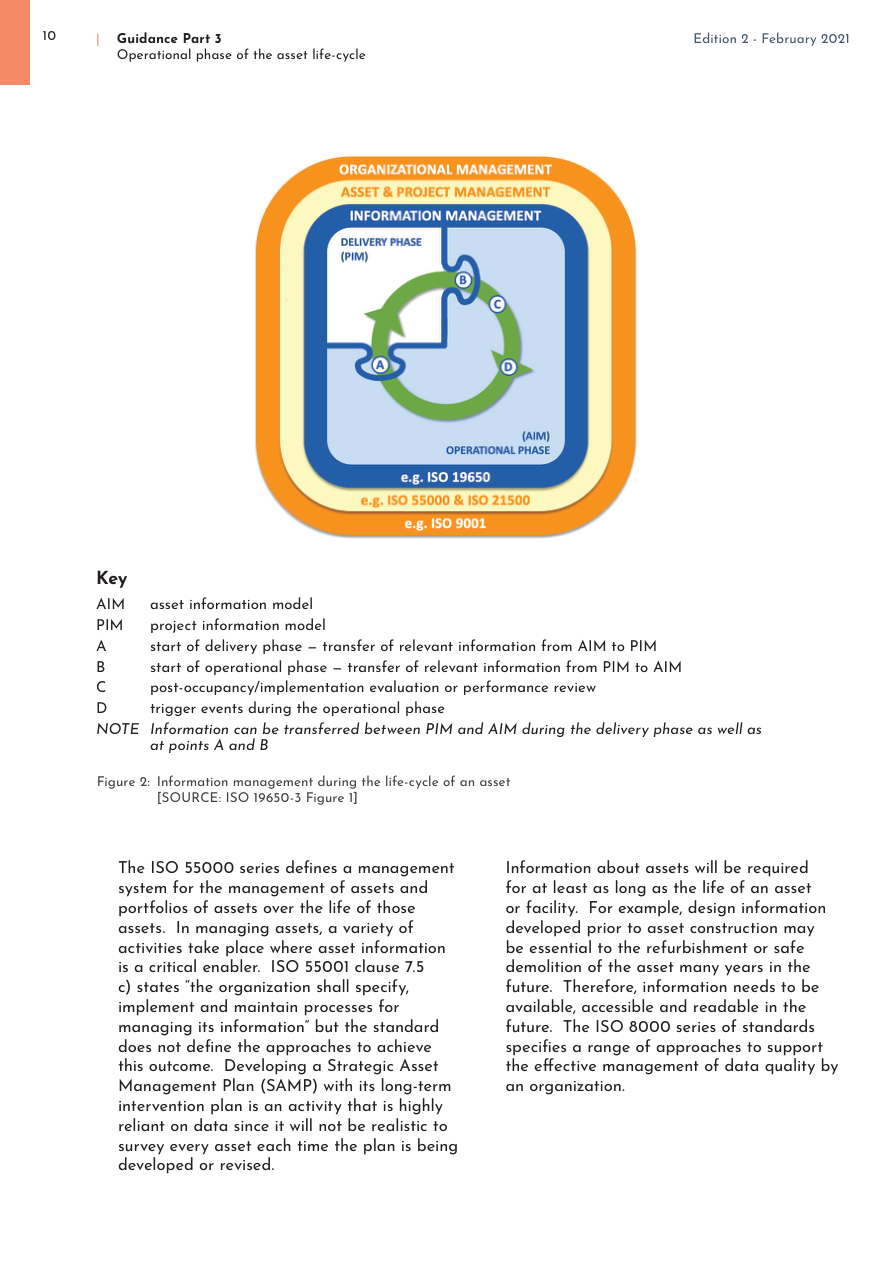
and facilities Information in the context of asset The ISO 19650 series supports asset management requires the specification, management and defines the approaches production, exchanging, checking and to information that comprise both project approval of information. Information should activities in part 2 and, in part 3, operational be structured and consistent and, where phase activities of assets. ISO 19650-3 Figure possible, support predictable and repeatable 1 illustrates the relationship between the outcomes. Information should be seen as a two sets of standards and the relationship valuable asset in its own right, and with its between delivery phase activities (defined in own performance criteria. Performance can ISO 19650-2) and operational phase activities be economic by measuring its link to a return (defined in ISO 19650-3). This is shown in on investment or reduction of liability, and Figure 2 below. can also relate to its relevance to support the asset management process. Asset management is defined in ISO 55000 as “coordinated activity of an organization to realize value from assets”. An asset is defined as an “item, thing or entity that has potential or actual value to an organization”. Asset management covers all types of assets, including buildings and facilities, which in ISO 55000 are collectively known as an asset portfolio. Asset management covers all parts of the asset lifecycle for the asset portfolio including the operational phase, which is defined in ISO 19650-1 as “part of the life cycle, during which an asset is used, operated and maintained”. The operational phase refers to the time when assets are delivering value to the organization and usually will not be undergoing construction, extension or major changes. There will, however, usually be a continuous stream of minor changes taking place as a result of inspections, maintenance and replacement of small-scale components. The ISO 55000 asset lifecycle includes create or acquire, operate and maintain, and dispose or replace.
10 | Guidance Part 3 Edition 2 - February 2021
Operational phase of the asset life-cycle Key AIM asset information model PIM project information model A start of delivery phase — transfer of relevant information from AIM to PIM B start of operational phase — transfer of relevant information from PIM to AIM C post-occupancy/implementation evaluation or performance review D trigger events during the operational phase NOTE Information can be transferred between PIM and AIM during the delivery phase as well as at points A and B Figure 2: Information management during the life-cycle of an asset [SOURCE: ISO 19650-3 Figure 1] The ISO 55000 series defines a management Information about assets will be required system for the management of assets and for at least as long as the life of an asset portfolios of assets over the life of those or facility. For example, design information assets. In managing assets, a variety of developed prior to asset construction may activities take place where asset information be essential to the refurbishment or safe is a critical enabler. ISO 55001 clause 7.5 demolition of the asset many years in the
- c) states “the organization shall specify, future. Therefore, information needs to be
implement and maintain processes for available, accessible and readable in the managing its information” but the standard future. The ISO 8000 series of standards does not define the approaches to achieve specifies a range of approaches to support this outcome. Developing a Strategic Asset the effective management of data quality by Management Plan (SAMP) with its long-term an organization. intervention plan is an activity that is highly reliant on data since it will not be realistic to survey every asset each time the plan is being developed or revised.
11 | Guidance Part 3 Edition 2 - February 2021
Operational phase of the asset life-cycle The adoption of information management The availability of complete, current, accurate approaches as defined in the ISO 19650 series and trusted information about an asset or significantly increases the quantity and quality facility will deliver benefits across various of digital information about assets, known as phases of the asset lifecycle: digitization, and, if linked dynamically to the physical asset, can be referred to as a ‘digital • During project phase activities, supported twin’. by ISO 19650-2; • During steady state operation and Asset owners with large portfolios of assets maintenance activities; and infrastructure are likely to have many • When planning and delivering reactive assets and facilities which are simultaneously interventions which could range from a at different stages in their asset lifecycles. simple component replacement, through For example, around 90% of the assets of a to responding to major incidents and utility may be in the operational phase, whilst supporting the business continuity plans of only around 10% are involved in the project the asset owners; phase (construction, refurbishment or end of • When developing or revising Strategic Asset life activities). During each phase, information Management Plans; will be being created, but will also act as a key enabler. • When planning future asset interventions; • When selling or transferring the asset to Facility managers may operate a portfolio of new owners; and buildings which have similar requirements or • At end of life to support safe, cost effective perhaps may only be interested in a single asset decommissioning and disposal. building. In either case, these may be in the operational phase, or be in a project phase prior to entering the operational phase. In all cases, the asset owner should recognize the need to manage the information about the facilities for current and future owners and stakeholders of the building(s). The supply chain involved in asset management activities has a responsibility in supporting the asset owners and delivering the information requirements specified for their appointment. BS 8536-1 and BS 8536-2 provide guidance which helps asset owners to define information requirements which support whole-life activities. Providing information is a key part of asset interventions and requirements for the provision and use of asset information should be defined contractually. Asset owners/operators should make sure their contracts and work instructions include these requirements for information alongside the technical specification of the works themselves.
12 | Guidance Part 3 Edition 2 - February 2021
Operational phase of the asset life-cycle
2.2 How ISO 19650-3 reflects the concepts and principles of ISO
19650-1 ISO 19650-3 defines the information 6. Information deliverables are collated into management process through a series of information models that are exchanged eight steps with loops and branches defined between delivery teams (asset/facility by questions and decisions. Figure 5 in this contractors) and the appointing party guidance reproduces the process flowchart (asset owner/operator), and may then be and some of the details in it are explained in passed on to other stakeholders such as a section 4. regulator The process as a whole reflects the concepts 7. Information production and review, and principles from ISO 19650-1. This means including authorization and acceptance, that it includes the following features: uses the common data environment (CDE) workflow and whatever CDE 1. The information management process solutions the various parties wish to apply is to be applied in a way that is proportionate to the scale and complexity 8. Information models from various delivery of the asset owner/operator, the asset(s) teams are federated to generate the in question, the trigger events that occur asset information model, that can in relation to the asset, the works required then be used throughout the asset’s to respond to the trigger events, and the operational life for analysis, reporting information required as a result of the or other uses that satisfy the information work done. purposes 2. Information deliverables are produced 9. The asset information model needs to in response to information requirements be maintained during the operational which themselves are developed from a life of the asset so that it continues to clear set of information purposes represent the state and condition of the asset. 3. Information delivery has to be planned in advance, starting during the tender process (for external contracts) or internal works negotiation and then continuing into a mobilization period before the technical work itself is started 4. The capacity and capability of delivery teams to comply with ISO 19650-3 are taken into account when making appointments 5. Information deliverables are produced using an agreed asset information standard and in accordance with agreed methods and procedures. This includes producing information deliverables to an agreed amount of detail, as defined through the level of information need framework
13 | Guidance Part 3 Edition 2 - February 2021
Operational phase of the asset life-cycle All of these features will be familiar to users of ISO 19650-2 since the underlying concepts and principles are also all reflected in that standard. Like most standards, ISO 19650-3 is a voluntary document. By itself it conveys no obligation to use it. But following the approaches defined in ISO 19650-3 should increase the efficiency and effectiveness of information management processes and support the objectives of all parties, particularly the appointing party (asset owner/operator). The obligation to use ISO 19650-3 has to be created. This could be through it being included or cited in a contract between an asset owner/operator and an external contractor. It could also be through adoption of an organizational policy covering the departments and staff that act as asset owner/operator and as works teams/internal contractors.
14 | Guidance Part 3 Edition 2 - February 2021
Operational phase of the asset life-cycle
3.0 Parties and responsibilities
3.1 Introduction
Effective information management is central to any asset management strategy; therefore, to manage and operate their assets successfully, owners/ operators need to clearly understand and specify what their exact information requirements are and the delivery of those. Asset information deliverables also support and inform an owner/organization’s asset management system, the approach outlined in ISO 55000. This approach should direct, coordinate, and control related management activities to deliver key organizational objectives such as statutory compliance, and value-based benefits during an asset’s lifecycle. An information management strategy and aligned delivery processes can therefore unlock greater insights, efficiency gains, and exponential value for the client organization and its supply chain partners. ISO 19650-3 establishes an information management process for asset owners/ operators (referred to as “appointing party”) to plan and procure their asset information requirements across different and varying portfolios, assets, delivery process pathways and associated trigger events. The ISO 19650-3 information management process further establishes a range of set activities to be undertaken by delivery teams (each consisting of a lead appointed party and one or more appointed parties) during the information planning and production stages. This consistent approach improves delivery teams’ collaboration and integration, particularly when new or updated asset information deliverables are being produced, shared, and coordinated simultaneously on the same, or across several projects and scenarios.
15 | Guidance Part 3 Edition 2 - February 2021
Operational phase of the asset life-cycle
3.2 Parties
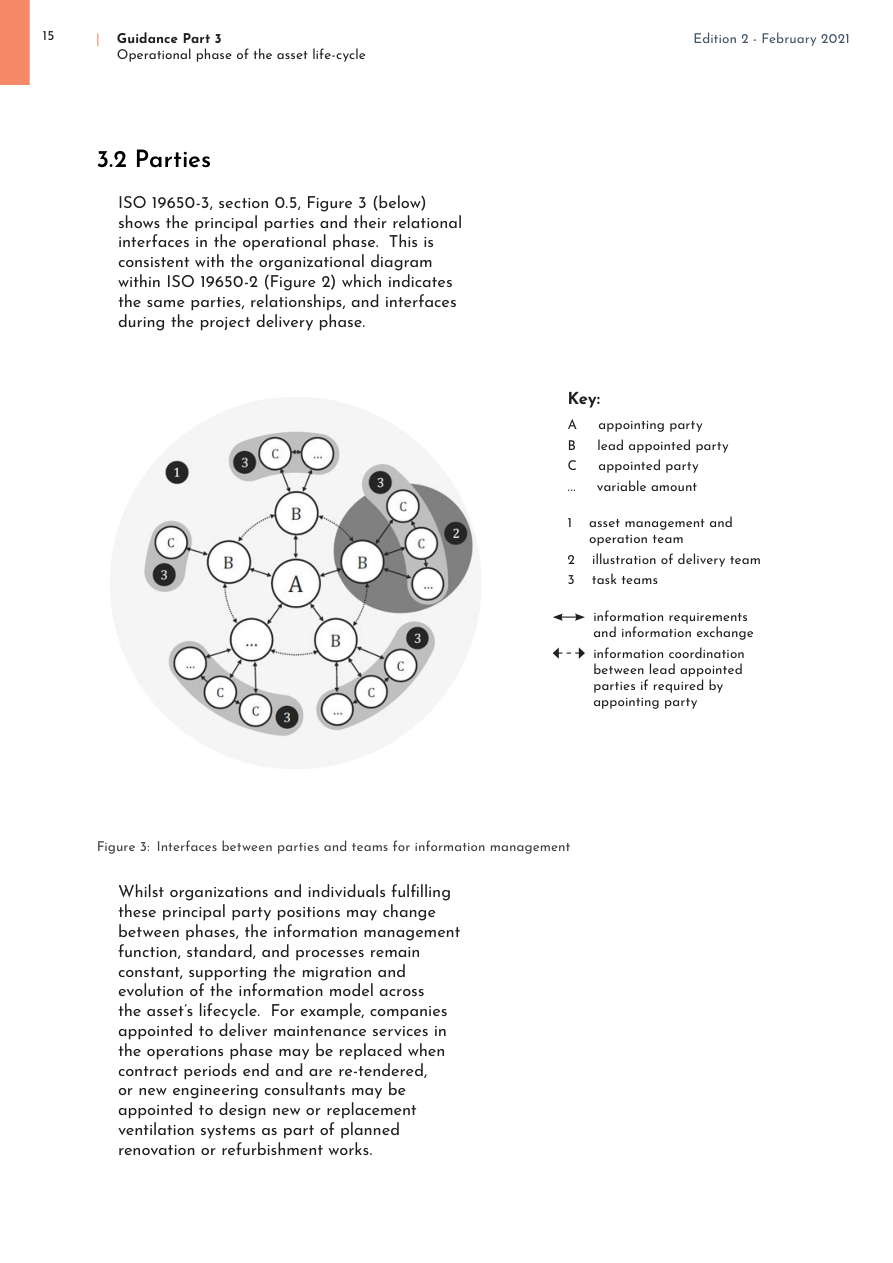
ISO 19650-3, section 0.5, Figure 3 (below) shows the principal parties and their relational interfaces in the operational phase. This is consistent with the organizational diagram within ISO 19650-2 (Figure 2) which indicates the same parties, relationships, and interfaces during the project delivery phase. Key: A appointing party B lead appointed party C appointed party ... variable amount
1 asset management and
operation team
2 illustration of delivery team
3 task teams
information requirements and information exchange information coordination between lead appointed parties if required by appointing party Figure 3: Interfaces between parties and teams for information management Whilst organizations and individuals fulfilling these principal party positions may change between phases, the information management function, standard, and processes remain constant, supporting the migration and evolution of the information model across the asset’s lifecycle. For example, companies appointed to deliver maintenance services in the operations phase may be replaced when contract periods end and are re-tendered, or new engineering consultants may be appointed to design new or replacement ventilation systems as part of planned renovation or refurbishment works.
16 | Guidance Part 3 Edition 2 - February 2021
Operational phase of the asset life-cycle A simple explanation of the ISO 19650-3 of (asset-related) information requirements. parties, relationships, and their typical real- The distinction between a lead appointed world personas follows: party and an appointed party is that a lead appointed party is only concerned with The (asset-related) appointing party is the managing the information process in their organization requiring and receiving the team whereas the appointed parties carry asset information. They can be the property/ out the technical work and generate the asset owner, an estates department, an associated information. An appointed party’s internal asset management team, or an outputs feed into or forms part of their lead outsourced operator / asset manager (usually appointed party’s overall deliverables to the on a medium-to-long term contract from the appointing party (asset owner/ operator). legal asset owner). They have authority and responsibility for the long-term operations These relationships are illustrated in the and management of the asset or asset following examples and in Figure 4. portfolio, and they ensure the required asset information is correctly specified, received, Example 1: As part of a periodic condition and maintained to support the whole asset survey contract of a whole building, a lifecycle. The appointing party prepares a service contractor may carry out all the work set of information management resources themselves, in which case they are the lead to define the quality of information and appointed party and the only appointed party the processes and protocols governing its – see Figure 4(a). production and ownership. Example 2: The service contractor from A lead appointed party is directly appointed Example 1 may do most of the work by the appointing party to manage the themselves but also appoint a specialist delivery of a specific set of asset-related company to conduct an intrusive survey of information. This title only applies to known asbestos – see Figure 4(b). information management according to the Example 3: An in-house asset manager ISO 19650 standards. The same organization (representing the asset owner) may appoint or team will almost certainly also be delivering an in-house survey team to carry out the the technical services, or functions that survey, in which case the survey team is also generate the required information (see both lead appointed party and an appointed appointed party, below) or outcome which party. The in-house team sub-contracts the includes the delivery of (asset-related) specialist asbestos survey to an external information requirements. For example, a specialist, who is also an appointed party – lead appointed party can be an in-house see Figure 4(c). maintenance team carrying out periodical statutory or routine maintenance checks, or an external contractor appointed to replace a faulty plant item or install a new lift or fire alarm system. In the case of a small in-house maintenance job this might involve just one maintenance engineer as lead appointed party answering to an individual asset manager as appointing party. The overall process is the same but clearly it is applied in a proportionate way – see section 4.3. An appointed party is appointed by the lead appointed party to generate and deliver a specific set of asset-related information. This information relates to the appointed party’s particular technical sub-services, subfunctions or works which includes the delivery
17 | Guidance Part 3 Edition 2 - February 2021
Operational phase of the asset life-cycle Appointment Appointment Appointing party Lead appointed party Appointed party For example the Service contractor for Service contractor for the building owner the condition survey condition survey (does all the work) Figure 4(a): Simple party relationships/appointments Appointed party Appointment Service contractor Appointment (does most the work) Appointing party Lead appointed party Building owner Service contractor for the condition survey Appointment Appointed party Specialist asbestos surveyor Figure 4(b): Multiple external appointed party relationships/appointments Appointed party Appointment In-house survey team Appointment (does most the work) Appointing party Lead appointed party Building owner’s In-house survey team in-house asset Appointment manager Appointed party Specialist asbestos surveyor Figure 4(c): Mixed internal/external appointed party relationships/appointments Different real-world scenarios, e.g., the type/ number of physical assets, their owner, how they are managed, and the procurement approach will generate different organizational arrangements of appointing party, lead appointed party/ies and appointed party/ies.
18 | Guidance Part 3 Edition 2 - February 2021
Operational phase of the asset life-cycle
3.3 Responsibilities
The UK BIM Framework Guidance part 2, sections 1.3, 1.4 and 1.5 explain the activities and outputs which each appointing party, lead appointed party and appointed party should fulfil when adopting ISO 19650-2, the delivery phase of assets. Many of these activities and outputs are repeated and relevant in ISO 19650-3, the operational phase of the asset lifecycle. However, there are several principal differences and responsibilities which are summarized in Table 2 and the following subsections. Detailed insights for each of the clauses in Table 2 are given in section 8. Table 2: New responsibilities in ISO 19650-3 compared to ISO 19650-2 ISO 19650-3 clause Responsibility
5.1.2 (establish organizational information requirements) Appointing party
5.1.3 (identify assets for which information shall be managed) Appointing party
5.1.4 (establish asset information requirements) Appointing party
5.1.5 (identify foreseeable trigger events for which information shall be managed) Appointing party
5.1.10 (establish links to enterprise systems) Appointing party
5.1.11 (establish asset information model) Appointing party
5.1.12 (establish processes to maintain asset information model) Appointing party
5.2.1 (decide type of activity providing information) Appointing party
5.5.4 (maintain resources in readiness for a trigger event) Lead appointed party
5.8.1 (aggregate an accepted information model into the asset information model) Appointing party
5.8.2 (review and continue maintenance of the asset information model) Appointing party
19 | Guidance Part 3 Edition 2 - February 2021
Operational phase of the asset life-cycle
3.3.1 Assessment and need for information
The appointing party is responsible for Further OIR and AIR guidance is available in defining their organizational information section 8 (insight for clauses 5.1.2 and 5.1.4) requirements (OIR) which identify what and in Guidance Part D. information is needed to satisfy and support the delivery of agreed strategic objectives Through the establishment and upkeep of the within the organization. For example, an AIR, an appointing party can identify and estates department could have OIR regarding collate a series of foreseeable trigger events the completeness of statutory compliance which will occur over an asset’s lifecycle. Each records for risk analysis or insurance purposes. trigger can represent a single or repeating planned event with associated actionable Identification of OIR will enable an asset task(s) and new or updated information owner/ operator to identify their priority requirements. For example, following a assets and what associated information is boiler service an actionable task could be the required and needs to be managed. This update of the logbook, or during a period will inform the establishment of the asset of mothballing or building vacancy the information requirements (AIR) which the actionable task could be to perform legionella asset owner/operator/departments or other tests on a school water system. Further stakeholders will need to operate, monitor, trigger event guidance is available in sections and manage specific systems and assets. For 4.2, 6 and 8 (insight for clause 5.1.5). example, an in-house asset management team may require assets and spatial locations to be ISO19650-3 is applicable to assets of all named or tagged using a unique identification sizes and all levels of complexity, many of code or naming convention, for onward which will be existing buildings and pieces linking or importing into an existing enterprise of infrastructure. It is likely many existing management system (e.g., EDMS, CAFM). assets will be using existing enterprise systems to store and manage asset information, The AIR will change and refresh as parts of and it may not be feasible to set up a new the physical asset and their systems adapt, or centralized information management update, or are replaced during the operational system when adopting this standard. It is the lifecycle. For example, replacing a gas-fired appointing party’s responsibility to ensure any heating system with a mixture of renewable new or continued use of existing systems can technologies will affect the information that support the requirements of ISO 19650-3, and is required to manage the new systems and can be maintained accordingly. This is critical this will lead to a replacement set of AIR. The to establish the asset information model and appointing party is responsible for ensuring ensure its long-term integrity across one or the OIR and AIR are fully aligned and kept many enterprise information systems. Further up to date in line with their needs. The AIR guidance is available in sections 7 and 8 should be structured in a way which is easily (insight for clauses 5.1.10). apportioned and assignable to the relevant lead appointed party at each invitation to However, where the assets are relatively tender stage. This ensures there is clarity of simple and the appointing party’s scope in terms of: requirements are relatively straightforward, it need not be complicated or expensive to • information required establish the different sets of information • how it is delivered / exchanged (exchange requirements, to incorporate the exchange information requirements) information requirements into relevant • the ability to procure a more accurate and contracts and to configure existing information comparable tender cost returns from the systems to be able to hold any new pieces of prospective contractors information that are deemed necessary. A • helping to avoid the risk of downstream simple approach can satisfy the requirements duplication or overlap of information during of ISO 19650-3 – complexity is certainly not a production. requirement.
20 | Guidance Part 3 Edition 2 - February 2021
Operational phase of the asset life-cycle
3.3.2 Tender stage and mobilization 3.3.3 Asset Information handover and
aggregation The appointing party (asset owner/ operator) is responsible for appointing a lead appointed The appointing party (asset owner/ party in relation to one or more trigger events. operator) is responsible for the final review This may be through a formal tender process, and acceptance of all asset information especially where external contractors are delivered by each lead appointed party, involved, but may also be through internal and the onward update or replacement of appointments such as through works orders or existing asset information content within instructions. It is also possible to make term- the relevant enterprise system(s). The appointments with call-off arrangements for precise legal responsibilities and liabilities each discrete piece of work. It is important around acceptance of information need to to note if in-house teams are appointed or be explained in the contract governing the assigned to provide trigger related services appointment, including what happens if the same level of responsibilities and process information appears to be complete but later should be applied. turns out not to be. ISO 19650-3 requires that an information protocol is incorporated Where trigger events are foreseeable, the into all appointments to cover these aspects. information management process and asset The same requirement in ISO 19650-2 has information requirements can be pre-defined given rise to the publication of a standard and lead appointed party(s) appointed in information protocol that is appropriate advance of the needed works. The frequency for design and construction contracts. No of trigger events may vary according to asset, equivalent protocol for Part 3 has been work order type, or contractual/ statutory written as yet, but the Part 2 protocol could be requirements. During long or inactive periods, consulted to give an indication of what might the lead appointed parties should either be needed. remain mobilized or provide assurance of their ability to mobilize when required, and have The appointing party is responsible for the necessary resources in place to complete the central or linked enterprise system(s) scheduled or planned trigger events. which support/host the AIM. The system(s) must enable the AIM to be structured and In instances where unforeseen or unplanned maintained properly, and to continue to trigger event occur, the appointing party fulfil its overall purpose. Further guidance is will need to instigate a process to appoint available in section 8 (insight for clauses 5.8.1 an appropriate lead appointed party(s). and 5.8.2). Again, it is important to note if in-house teams are appointed or assigned to provide trigger related services the same level of responsibilities and process still should be applied. Further guidance is available in section 8 (insight for clause 5.2.1).
21 | Guidance Part 3 Edition 2 - February 2021
Operational phase of the asset life-cycle
4.0 Explaining the information
management flowchart (ISO 19650-3 Figure 4)
4.1 The flowchart
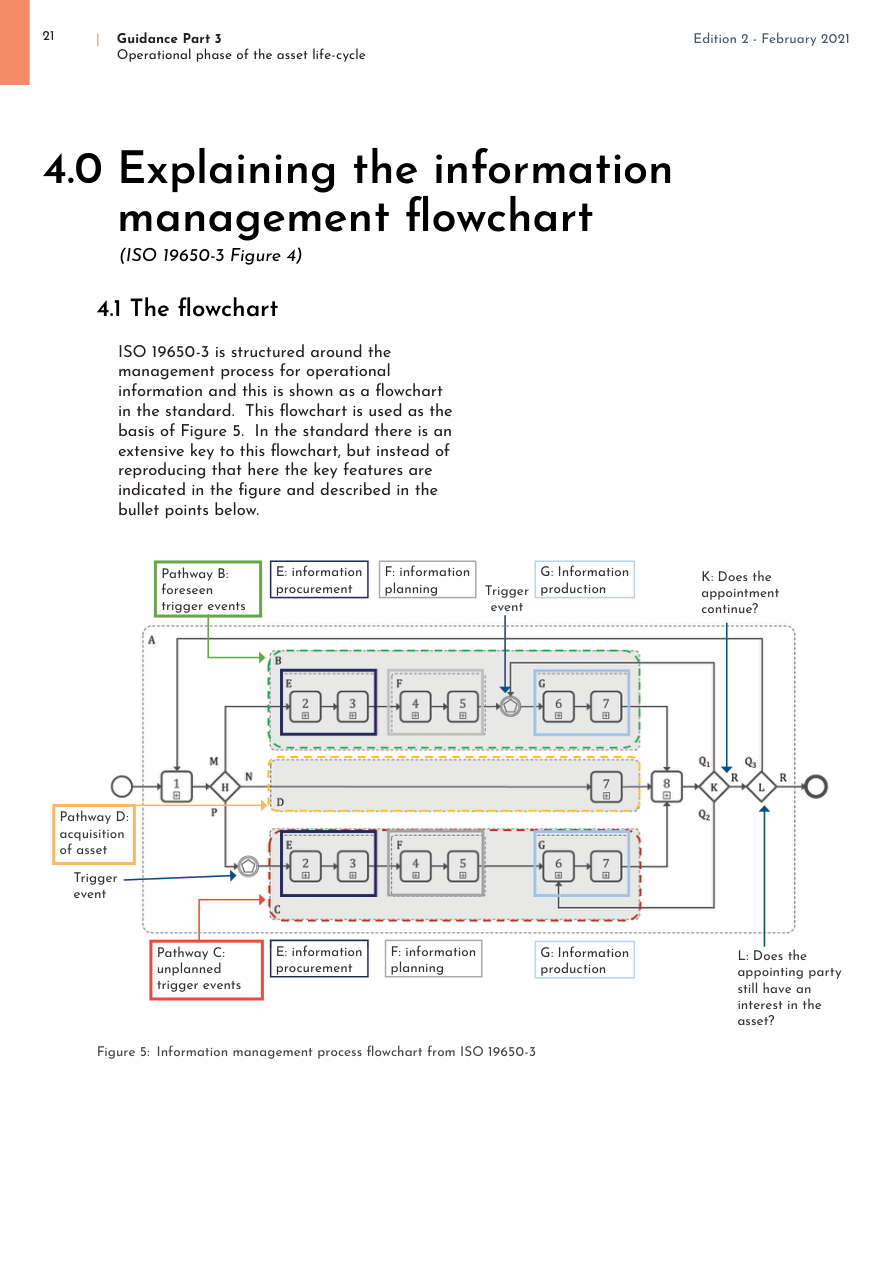
ISO 19650-3 is structured around the management process for operational information and this is shown as a flowchart in the standard. This flowchart is used as the basis of Figure 5. In the standard there is an extensive key to this flowchart, but instead of reproducing that here the key features are indicated in the figure and described in the bullet points below. Pathway B: E: information F: information G: Information K: Does the foreseen procurement planning Trigger production appointment trigger events event continue? Pathway D: acquisition of asset Trigger event Pathway C: E: information F: information G: Information L: Does the unplanned procurement planning production appointing party trigger events still have an interest in the asset? Figure 5: Information management process flowchart from ISO 19650-3
22 | Guidance Part 3 Edition 2 - February 2021
Operational phase of the asset life-cycle The key elements of the flowchart are as • Within the pathways B and C, the process is follows: broken into 3 sub-groups labelled E, F and G. • The process comprises eight steps, • Sub-group E is about procurement – of numbered 1 to 8, and the requirements a tier 1 contractor or an in-house team at each step are contained in the to be responsible for some information corresponding sub-clause of ISO 19650-3 deliverables (lead appointed party). clause 5 (for example, step 1 is covered by ISO 19650-3 covers information clause 5.1) procurement activities in clauses 5.2 and 5.3 • Step 1 of the process is where the • Sub-group F is about planning – appointing party (asset owner/operator) the mobilization of the appointed prepares for the rest of the information contractor or in-house team and the appointment of any further parties management process. This includes within the delivery team (appointed assessing what information they need parties). ISO 19650-3 covers at organizational and asset levels, and information planning activities in preparing all the supporting resources for clauses 5.4 and 5.5 the process such as the asset information • Sub-group G is about production standard and establishing the common data – when information is produced by environment appointed parties, reviewed by a lead appointed party and ultimately • Step 1 leads to three different pathways, accepted by the asset owner/operator shown as shaded boxes labelled B, C and D. (appointing party). ISO 19650-3 covers information production activities in • Which of these pathways is followed clauses 5.6 and 5.7 depends on the nature of each life- • These sub-groups of activities reflect cycle event giving rise to new or the overall philosophy described in updated asset information. ISO 19650 Part 1 and mirrors the • These events are called trigger events approach taken in ISO 19650 Part 2 for and are depicted in pathways B and C information management on projects by a circle enclosing a pentagon. • The process has feedback loops at points K • The pathways are split because there and L. are fundamental differences in the • Point K tests whether the appointment approach to information management, will continue following acceptance primarily around whether procurement of a particular set of information and mobilization can be done ahead of deliverables from the supplier (lead the trigger event taking place or not appointed party/delivery team). This could be because a trigger event is complex enough to involve a series of information exchange points (such as the design and then installation of an emergency roof). Or because it is a call-off appointment responding to a repeated trigger event where each has its own information exchange (such as a 5-year contract to conduct yearly inspections). • Point L tests whether the asset owner/ operator still has an interest in the asset and therefore whether the whole information management process should continue.
23 | Guidance Part 3 Edition 2 - February 2021
Operational phase of the asset life-cycle
4.2 Trigger events existing assets. When the trigger event
does happen, the appointing party has to start from the beginning of the procurement Trigger events are one of the key concepts for process (sub-group E), the lead appointed managing asset information according to ISO party and delivery team have to go through 19650-3. These are the events taking place the mobilization activities (sub-group F) during the life-cycle of the asset that have before they can start their technical work and an effect on the asset and give rise to new start producing information (sub-group G). or updated information being needed by the This means there will of necessity be some appointing party (asset owner/operator). They delay between the trigger event occurring and provide the overall tempo for the information the technical response work starting. management process, in the same way that plan of work stages do during a project. [TRIGGER] then [PROCURE] then [PLAN] There are many different trigger events that then [PRODUCE] can occur – some of them will arise on all or most assets such as planned maintenance of The third pathway, D in Figure 5, is driven by commonplace elements or equipment. Others the acquisition of an asset that is currently will be very specific to the asset in question owned by another organization. For example, such as undermining of foundations for a the purchase or leasing of a site or an existing structure near an eroding coastline. building. This is a particular kind of trigger event because the contractual relationship By their nature, some of these trigger between the buyer and seller is fundamentally events can be foreseen and scheduled or different from the client-supplier relationship otherwise planned for in advance of them created for the other types of trigger. During happening, for example regular maintenance asset acquisition, the buyer may have little or inspections. These are the trigger events ability to insist on the supply of certain that drive pathway B in the information pieces of information as part of the purchase. management process (see Figure 5). Planning It might be possible to negotiate this as for these trigger events means the appointing part of the price paid, or for the acquirer party (asset owner/operator) going through to commission their own due-diligence the procurement activities for information, and information. also for the works, (sub-group E) and the lead appointed party (contractor or in-house team) going through their mobilization activities (sub-group F) before the trigger event takes place. This means that when the trigger event occurs the delivery team is already appointed and ready to go, and can start immediately with their technical tasks and production of information (sub-group G). [PROCURE] then [PLAN] then [TRIGGER] then [PRODUCE] Other trigger events are acts of God, or random occurrences, or so infrequent or unpredictable that it is impractical to plan for them in advance, for example a lightning strike or an increase in customer demand requiring an additional production facility. These are the trigger events that drive pathway C in the information management process (see Figure 5). They include new delivery phase activities (new projects) to create new assets or refurbish/remodel
24 | Guidance Part 3 Edition 2 - February 2021
Operational phase of the asset life-cycle
4.3 Proportionality
Although the flowchart in Figure 5 looks Some of the specific tasks in ISO 19650-3, complicated, and each of the process steps such as the lead appointed party preparing contains a series of required actions, the ISO the delivery team’s BIM execution plan, 19650-3 information management process is are deliberately scaled down from their to be applied in a way that is proportionate equivalents in ISO 19650 Part 2. If more and appropriate to the scale and complexity detail is warranted by the situation then this of the asset portfolio as well as the scale can either be specified by the appointing and complexity of the asset management party in their acceptance criteria for the responses to trigger events. Proportionality is tender response or volunteered by the demonstrated through the following examples: prospective contractor/in-house team (lead appointed party) in their pre-appointment Example 1 :In preparing for their overall BEP. approach to information management in step 1, an appointing party (asset owner/operator) Proportionality also needs to be applied to might decide only to apply ISO 19650-3 to the organizational and asset information its most critical assets, such as only to its requirements that are developed by the asset production and warehouse facilities and not to owner/operator (appointing party). Each its administrative offices, or only to life safety information requirement must be able to systems rather than all systems in a building. be traced back to a purpose, so that the This would be part of the considerations in appointing party is clear that it is only asking response to ISO 19650-3 clause 5.1.3. for information to be produced that it really does need. This is part of the lean thinking Example 2: In procuring a new lead that underpins a systematic approach to appointed party (asset contractor) to carry information management, and the result out a condition survey, an appointing party should be sets of exchange information (asset owner/operator) could conclude that requirements for each lead appointed party none of its existing reference information or that focus on the information that really resources are relevant and do not need to be has value to the appointing party. Different included in the tender pack compiled for this asset owners/operators will have different appointment. This simplifies the paperwork of ideas of what information is of value to them the procurement process. – there is no single set of right or wrong answers to this question because the idea Example 3: An in-house asset manager of value can mean such different things to acting as appointing party and appointing different organizations. Even if a particular an in-house works team to do small-scale asset owner/operator draws on the work of work and information delivery will still similar types of organization (such as one need to go through the same information local authority learning from others), they management process steps. But at each should still approach the development of their step the details that need to be defined or information requirements with a critical eye. the resources that need to be created will be much simpler or might not be relevant and Much more explanation about determining so can be legitimately excluded. The cost of appropriate information requirements is given implementing the process will ultimately have in Guidance D. to be balanced against the benefit of having the intended information. Unless there is a statutory requirement to be met, this balance of cost versus value has to be made by the appointing party (asset owner/operator).
25 | Guidance Part 3 Edition 2 - February 2021
Operational phase of the asset life-cycle
5.0 Use cases for ISO 19650-3
This section illustrates three out of the Use Case 2. For portfolios of assets, potentially infinite number of Use Cases that progressively moving to follow UK BIM could be used across different asset owners Framework principles on a site-by-site basis. triggered by different situations. Adoption and use of ISO 19650-3 allows the appointing This is triggered when projects/interventions party (asset owner/operator) to adopt a are undertaken on more than a predefined proportionate approach based upon the costs proportion of the assets on the site. This and benefits of implementation. prevents ‘small’ projects/interventions, such as replacement of windows, requiring the Use Case 1. A single asset/building/facility digitization and surveying of a whole building. that moves from the project phase (defined in ISO 19650-2) to the operational phase Where the above threshold is passed, this (defined in ISO 19650-3). use case would involve digitizing all assets, documents and information for the site based This begins before the project is started, with on the Asset Information Requirements (AIR). definition of what information is needed to In addition to the benefits detailed in Use manage and maintain the asset/building/ Case 1 above, further benefits would be: facility. This information is collected during the project delivery where it forms part of the • Increasing the proportion of digital project information model (PIM). Effective information across an organization’s asset transfer of this information from the PIM into stock faster than if digital information the asset information model (AIM) without about assets was only collected through Use loss of meaning or accessibility provides a Case 1; range of benefits: • Increased understanding of the extent to which assets across whole sites/ facilities are • Reduced uncertainty about actual assets following UK BIM framework principles; and systems enabling more effective • Easier and closer relationship with facilities intervention planning; management activities facilitated through, • Reduced safety risks due to staff making for example, asset tagging and information unwelcome ‘discoveries’, such as previous maintenance linked to FM contracts. alterations to assets that had not been recorded, whilst undertaking asset interventions; • Quicker and more effective development of planned maintenance schedules to ensure that they are active on asset handover. This would reduce the risk of failures and the risk of reducing asset life through insufficient or incorrect early maintenance. This would also reduce the risk of invalidating a warranty by not following the manufacturer’s requirements; • More effective and quicker planning and response to unplanned incidents, such as fire/ flood/ damage through availability of more reliable information.
26 | Guidance Part 3 Edition 2 - February 2021
Operational phase of the asset life-cycle Use Case 3. For portfolios of assets, applying • Enables change in process/ maintenance UK BIM Framework principles to selected regimes for a complete asset/ site type asset/site types by surveying existing assets, perhaps including standardized planning digitizing drawings and records. and activities, common tooling, optimized training and reduced variability in approach For example, digitizing all air handling units or leading to greater efficiencies and improved digitizing all sub-station sites >50kV. This Use asset outcomes. Case could be applied alongside Use Case 2 or independently. In addition to the benefits These Use Cases are illustrated in Figure 6. detailed in Use Case 1 above, further benefits In the figure, assets on six different sites are would be: represented by geometrical shapes. Those that are subject to work following trigger • Increasing the proportion of digital events have a bold outline. In Use Case 2, information across an organization’s asset on Sites A, D and F some assets are subject stock faster than if digital information to projects/work that is above the predefined about assets was only collected through Use proportion for digitizing the whole site. In Use Case 1; Case 3 the pentagon asset has been selected • Increased understanding of the extent to for survey and digitization. This affects sites which assets across whole sites/ facilities are A, B and D but only that specific asset on following UK BIM framework principles; each site is digitized. Use Case 1 Site A Key • Shapes represent different asset types • Blue fill represents digitized assets • Grey fill represents assets not digitized • Bold outline represents assets with planned interventions Use Case 2 Site A Site B Site C Site D Site E Site F Use Case 3 Site A Site B Site C Site D Site E Site F Figure 6: Illustration of use cases for applying ISO 19650-3 process
27 | Guidance Part 3 Edition 2 - February 2021
Operational phase of the asset life-cycle
6.0 Example application of ISO 19650-
3 to a specific trigger event
6.1 Target audience 6.2 Definition and categorization
of trigger events in the This section is particularly for individuals working within or on behalf of an appointing operational phase of an party (asset owner/operator) to apply ISO asset
19650 to operational phase trigger events
and to establish the exchange information ISO 19650-3 clause 5.1.5 highlights trigger requirements for those trigger events. Where events as those events during the operational recommendations are made for specific phase when new or updated information trigger events, these are intended to represent concerning an asset will be generated or ‘good practice’. required. This section provides clarity on typical trigger Clause 0.1 of ISO 19650-3 highlights that events and provides an example of taking one there are 2 main types of trigger event: trigger event through the requirements of ISO 19650-3. 1. Those that are foreseeable and for which advanced planning is sensible 2. Those that are either unforeseeable or which can be foreseen but where advanced planning is not a sensible use of time or resources. Depending on the nature of a trigger event, preparatory activities can differ. Some example trigger events are suggested in ISO 19650- 3 Appendix A.3. It is important to understand that more than one trigger event can occur at the same time. Similarly, different types of asset, particularly at system or equipment level, can be subject to identical or similar trigger events. However, the asset management response and the asset information generated or updated might be different in each case. For example, many items of equipment will need maintenance trigger events, but the nature of the maintenance will be specific to each type of equipment. In addition, some trigger events can be identified independently from the assets, for example severe weather or geological activities. Once the assets have been identified it is possible that other trigger events will become apparent.
28 | Guidance Part 3 Edition 2 - February 2021
Operational phase of the asset life-cycle Figure 7 is a simplified illustration of one arrangement of trigger events for an asset in its operational phase. The grey loops at the left-hand end and towards the right of the figure represent an initial delivery phase (project) and a refurbishment. At these points, information management is according to ISO 19650-2. The period between the project and refurbishment shows a sequence of different types of trigger event. The details of these trigger events will be specific to the type of asset and to the particular asset itself. For example, road bridges will tend to have trigger events in common and Tower Bridge in London will have some specific trigger events because of its location, design, age and so on. Survey Maintenance Inspection Survey Inspection Refurbish Survey Maintenance Inspection Repairs Maintenance Repairs Maintenance Inspection Figure 7: Trigger events during the operational phase of the life cycle
29 | Guidance Part 3 Edition 2 - February 2021
Operational phase of the asset life-cycle
6.3 Categories of Trigger Events
in the asset lifecycle Although there are many possible trigger events, they can be grouped largely under four main headings, as shown in Figure 8. The lists of specific trigger events in Figure 8 are not exhaustive, and are included to indicate the range of possible trigger events that might need to be considered • ACQUIRE E • MAINTAIN • Maintenance R M o Acquisition of an asset UI AI • Inspections (Annualised Q N maintenance) C o Transfer of asset from T o H&S inspection A AI o Planned: scheduled construct phase to in-use N o Fire safety phase o Energy performance tasks INSPECTIONS o Reactive - o Onboarding: Asset SURVEY o Defects/warranty enhanced handover & inspections unscheduled tasks commissioning OPERATIONS o Proactive - inspect/ • Survey o Post occupancy evaluation MAINTENANCE monitor/condition o Measured survey based maintenance Initial aftercare period o Laser scan regimes o Transfer of ownership o Building services survey • RENEW REFURBISH • END OF LIFE o Stock condition surveys • Renewal (Forward o H&S survey, asbestos Maintenance) o Disposal E o Topography o Decommissioning N o Major repairs and D W o Utilities survey replacements RENEWAL E o Decontamination O F N o FM validation survey o Improvements/ o Deconstruction o Space utilisation LIFE RE upgrades o Demolition o Transfer of ownership • Operations (e.g. energy o Cleaning reductions) o Utilities o Redecoration o Waste management • Refurbishment and o Catering adaption o Hospitality o Major refurbishment o Helpdesk o Change of use o Post room o Alterations or churns o Security Figure 8: Example trigger events grouped by theme
30 | Guidance Part 3 Edition 2 - February 2021
Operational phase of the asset life-cycle
6.4 Worked example: 6.4.1 Scenario
Commissioning a survey to • Organization X has a large asset determine the extent of a portfolio consisting of both buildings and refurbishment infrastructure. • Organization X is keen to digitize their built asset portfolio in a staggered manner and The section highlights the information utilize the organization’s central repository management process associated with survey (CDE) embracing ISO 19650 principles. activities in preparation to refurbish the asset within the context of the scenario outlined • Previous survey work has highlighted that below. This particular trigger is classed as investment is required in the strategic an unforeseeable trigger, as it is not part of regional centre. The anticipated remaining a long-term schedule of asset activities. It is building life of the regional centre is 30 hoped to include an example of a foreseeable years. The outline business case to refurbish trigger (such as a regular maintenance the regional centre has been approved with activity) in a future update of this guidance. an objective to continue using the building as a regional centre. • Organization X now needs to procure a single supplier to undertake detailed surveys to support the full business case for the refurbishment of the existing building. These surveys will include building services, structural integrity, asset condition, and point cloud. The principal deliverable will be an information model that incorporates survey information. Due to poor existing legacy asset data, survey outputs will provide accurate validated data to inform the briefing stage of the refurbishment. • The regional centre is currently occupied and staff decant commences 8 weeks prior to the start of refurbishment works. • Organization X has an asset management system and computer aided facilities management system (CAFM) for managing their asset portfolio.
31 | Guidance Part 3 Edition 2 - February 2021
Operational phase of the asset life-cycle
6.4.2 Applying the clauses of ISO
19650-3 This section is to be read in conjunction with ISO 19650-3. The guidance in Table 3 presents key aspects tailored to the survey appointment in the context of the scenario outlined above. Table 3: Survey trigger example of ISO 19650-3 activities ISO 19650-3 ISO 19650-3 Activities/commentary clause sub-clause
5.1 Assessment 5.1.2 (OIR) Identify the OIRs relevant to survey outputs. For example: “To have accurate and
and need complete survey information in advance of any project”.
5.1.3 (Relevant Identify critical assets in the regional centre based on existing information held by
assets) the operations team.
5.1.4 (AIR) Specify the information required for each critical asset to support the OIR. Note:
clearly identify that the survey is non-intrusive and there will be limited data collection for elements with restricted access (such as behind walls). Identify the methodology for assets with limited information availability.
5.1.5 (Triggers) The foreseeable trigger event is the refurbishment of a regional centre.
Information collected as part of the survey will be managed during subsequent trigger events including maintenance, fabric/equipment repair, room reconfiguration. 5.1.6, 5.1.10 Highlight the use of survey information collected: information about system/ (Information component assets that require renewal will be used by the design team to inform standard and new design strategies while information on existing system/components assets Enterprise that will remain in situ will be used by maintenance and operations teams. State systems) the building services survey, structural survey, measured survey, utilities and asset condition information is to be incorporated in an information model and aligned to the defined level of information need. Capture existing enterprise system requirements (CDE, CAFM, etc.) to specify the asset taxonomies, location hierarchy, classifications to inform the asset information standard. The information standard should also set out survey accuracy bands, tolerances, coordinate grid and datum requirements and format of deliverables. 5.1.7, 5.1.8 Clearly identify that there is poor quality legacy information about the regional (Methods and centre and validation of legacy information is therefore required. Where procedures, information does not exist within legacy, the survey team will be required to and Reference collect information in line with the specification in the information standard. One information) key area for consideration is the interoperability of outputs for onward use such as exchange between survey packages, so the information production procedures will encourage use of open standards where possible. Data collection templates, object library definition to be shared with prospective surveying tenderers.
5.1.11 (Establish Clearly state that survey outputs will be federated to create the refurbishment
AIM) information model (where existing system/component assets are retained as part of the refurbishment). Methodology for aggregating the information into any existing AIM needs to be defined.
32 | Guidance Part 3 Edition 2 - February 2021
Operational phase of the asset life-cycle ISO 19650-3 ISO 19650-3 Activities/commentary clause sub-clause
5.2 Invitation 5.2.2 (EIR) As part of the exchange information requirements for this trigger event it is
to tender/ essential to specify the level of information need for each asset category whilst request to considering the availability of information on asset with restricted accessibility. provide service 5.2.3, 5.2.5 Include the information compiled as part of 5.1.8 (Assemble reference information and Compile tender information)
5.2.4 (Response Given that refurbishment designs will rely on survey outputs and deliverables,
requirements) it is essential that evaluation criteria for the surveying appointment cover the tenderer’s experience of refurbishment projects and their information-based risks. As the survey work has to be completed within X weeks, clear capacity to deliver the required information must be shown.
5.3 Response 5.3.2 (BEP) Assess the proposed methodology to meet the exchange information
to tender/ requirements. request to provide service 5.3.3 (Capability Assess tenderers’ capability and capacity based on the criteria set within 5.2.4. and capacity)
5.4 5.4.6 (Complete Consider any changes to the asset information standard and the information
Appointment appointment) production methods and procedures that have been proposed by the selected survey organization. Incorporate any agreed updates to these in the appointment documents.
5.5 Make sure that the appointment of the surveyor is finalized so that there is
Mobilization enough time for mobilization activities before the survey work itself needs to start.
5.6 Production This clause has no specific activities or commentary for the appointing party.
of information However, it is essential that the information standard (see 5.1.6) and the EIR (see 5.2.2) are specific on the data requirements for each type of object to be collected by the survey and the exchange format expected. Ideally this should be through the provision of detailed data collection templates and object library definitions and in a recognized open standard such as BS1192-4. .
5.7 5.7.2 (Accept It is essential to undertake quality assurance checks on each information
Information information container and the object data provided. Assurance checks could use automated model model) computerized verification against the information standard and EIR and should acceptance take place before the information exchange is contractually accepted. Utilize the review comment and accept workflow within the CDE to aid quality assurance checks.
5.8 AIM 5.8.1 (Aggregate Given poor quality legacy information, survey outputs serve as the most up to
aggregation AIM) date validated data set for the regional centre. Update enterprise systems with the survey deliverables to ensure any updates are federated within the new information model for the regional centre.
5.8.2 (Review Compile an AIM maintenance methodology that would support the future
AIM) activities associated with the refurbishment of the regional centre.
33 | Guidance Part 3 Edition 2 - February 2021
Operational phase of the asset life-cycle
7.0 Integrating information delivered
through ISO 19650-3 into existing systems ISO 19650-3 clause 5.1.10 allows for existing It is recommended that the process to extract, systems to be used to store delivered asset transform and load the accepted and assured information. It also notes that these systems information into an interim repository is can be outside the direct control of the separated from the enterprise integration appointing party (asset owner/operator). process. There may be any number of target enterprise systems to integrate and this The process of importing information into approach enables each system integration to existing live line-of-business systems should be profiled and carried out separately. This be considered carefully, irrespective of delivers a scalable and controlled approach whether this information comes from a live with the option to roll back to an earlier project (delivery phase) or an operational position with full audit trail. activity (such as a maintenance trigger event). Importing partial, corrupted, or poorly While this may appear complex, attempts at identified or structured information is a high direct integration have often failed in practice business risk. Manual update of enterprise leading to significant loss of potential benefit systems is also not scalable and prone to error. from the whole information management process. Similarly, a manual approach would To avoid or reduce these risks, it is be overwhelmed. recommended that a multi staged semiautomated approach is adopted. Experience with UK Government Departments and Agencies has shown that the staged An example of this is shown in Figure 9 and approach can be justified by significant proposes that: improvements in information quality and completeness, and reduced latency (lag) • The information received should be stored in integrating the information through an in an immutable ‘system of record’, automated process. This also minimizes • A combination of manual validation and mundane, unreliable and unscalable manual automated verification processes should handling of information. be used to confirm that the information received is acceptable prior to any system Further work to provide more detailed integration. information on this approach is underway. • Accepted information should be extracted, transformed and loaded1 into an interim staging repository, • System integration should be profiled separately for each existing system from the assured repository.
1 This is often shortened to ETL
34 | Guidance Part 3 Edition 2 - February 2021
Operational phase of the asset life-cycle Contract Program Line AIM & PIM Integration Management Inventory & Immutable Assured Automated Planning Information Automated Container Structured System Exchange Verification (File) Store Repository Integration Cost & Carbon Reporting Asset Performance Enterprise Systems Figure 9: A staged approach to Integrating ISO 19650-3 into existing information systems
35 | Guidance Part 3 Edition 2 - February 2021
Operational phase of the asset life-cycle
8.0 ISO 19650-3 clause 5: insight
This section of the guidance provides some additional insight into certain parts of clause 5, which as a whole defines the information management process. Many of the detailed clauses are recognizably similar to those in ISO 19650-2 and some initial insight on these can be gained from ISO 19650 Guidance Part 2, section 2. Table 4 lists all the parts of clause 5 and shows whether insight can be found in this section or whether the nearest insight currently available is in Guidance Part 2. Table 4: Where to find insight text for ISO 19650-3 clauses ISO 19650-3 clause Location of insight
5.1.1 (appointing party information management function) Guidance Part 2, clause 5.1.1
5.1.2 (establish organizational information requirements) This guidance – see below
5.1.3 (identify assets for which information shall be managed) This guidance – see below
5.1.4 (establish asset information requirements) This guidance – see below
5.1.5 (identify foreseeable trigger events for which information shall be This guidance – see below
managed)
5.1.6 (asset information standard) Guidance Part 2, clause 5.1.4
5.1.7 (asset information production methods and procedures) Guidance Part 2, clause 5.1.5
5.1.8 (establish reference information and shared resources) Guidance Part 2, clause 5.1.6
5.1.9 (common data environment) Guidance Part 2, clause 5.1.7
5.1.10 (establish links to enterprise systems) This guidance – see below
5.1.11 (establish asset information model) This guidance – see below
5.1.12 (establish processes to maintain asset information model) This guidance – see below
5.1.13 (asset information protocol) Guidance Part 2, clause 5.1.8
5.2.1 (decide type of activity providing information) This guidance – see below
5.2.2 (appointing party’s exchange information requirements) Guidance Part 2, clause 5.2.1
5.2.3 (assemble reference information and shared resources) Guidance Part 2, clause 5.2.2
5.2.4 (response requirements and evaluation criteria) Guidance Part 2, clause 5.2.3
5.2.5 (compile invitation to tender/request to provide service) Guidance Part 2, clause 5.2.4
5.3.1 (lead appointed party information management function) Guidance Part 2, clause 5.3.1
36 | Guidance Part 3 Edition 2 - February 2021
Operational phase of the asset life-cycle ISO 19650-3 clause Location of insight
5.3.2 (establish pre-appointment BIM execution plan) Guidance Part 2, clause 5.3.2
5.3.3 (task team capability and capacity) Guidance Part 2, clause 5.3.3
5.3.4 (delivery team capability and capacity) Guidance Part 2, clause 5.3.4
5.3.5 (delivery team mobilization plan) Guidance Part 2, clause 5.3.5
5.3.6 (delivery team risk register) Guidance Part 2, clause 5.3.6
5.3.7 (compile delivery team response) Guidance Part 2, clause 5.3.7
5.4.1 (confirm BIM execution plan) Guidance Part 2, clause 5.4.1
5.4.2 (detailed responsibility matrix) Guidance Part 2, clause 5.4.2
5.4.3 (lead appointed party’s EIR) Guidance Part 2, clause 5.4.3
5.4.4 (task information delivery plans) Guidance Part 2, clause 5.4.4
5.4.5 (master information delivery plan) Guidance Part 2, clause 5.4.5
5.4.6 (complete lead appointed party’s appointment) Guidance Part 2, clause 5.4.6
5.4.7 (complete appointed party’s appointment) Guidance Part 2, clause 5.4.7
5.5.1 (mobilize resources) Guidance Part 2, clause 5.5.1
5.5.2 (mobilize information technology) Guidance Part 2, clause 5.5.2
5.5.3 (test asset information production methods and procedures) Guidance Part 2, clause 5.5.3
5.5.4 (maintain resources in readiness for a trigger event) This guidance – see below
5.6.1 (availability of reference information and shared resources) Guidance Part 2, clause 5.6.1
5.6.2 (generate information) Guidance Part 2, clause 5.6.2
5.6.3 (quality assurance check) Guidance Part 2, clause 5.6.3
5.6.4 (approve information for sharing) Guidance Part 2, clause 5.6.4
5.6.5 (review information model) Guidance Part 2, clause 5.6.5
5.6.6 (authorize information model for delivery to appointing party) Guidance Part 2, clause 5.7.2
5.7.1 (submit information model for appointing party acceptance) Guidance Part 2, clause 5.7.3
5.7.2 (review and accept information model) Guidance Part 2, clause 5.7.4
5.8.1 (aggregate an accepted information model into the asset information This guidance – see below
model)
5.8.2 (review and continue maintenance of the asset information model) This guidance – see below
The rest of this section focuses on the clauses that are different from those in ISO 19650- 2, as these are particularly focused just on information management during asset and facility operation.
37 | Guidance Part 3 Edition 2 - February 2021
Operational phase of the asset life-cycle Clause: 5.1.2 Establish organizational information requirements See ISO 19650 guidance D to understand more about information requirements The primary party active Insight: within the clause: Organizational information requirements (OIR) are defined by the appointing party Appointing party (asset owner/operator). They identify the information needed to satisfy strategic objectives within the organization. OIR in general, do not have to be related to assets Contributing parties to the or asset performance (for example, a commercial business might have an OIR around clause: filing its statutory accounts), but the asset related OIR are the focus of ISO 19650-3. n/a When the activity within OIR are likely to come from a range of departments across the organization, not just the clause should be the facilities or asset management team. OIR represent the high-level information those departments need to feed in to their own activities. They can also come from carried out: external stakeholders such as shareholders, lenders or regulators. Before tendering the first lead appointed party appointment Example 1: The marketing department of a hotel chain could require information (OIR) about the condition of public spaces (such as reception areas, restaurants, bars) The level of the activity: across all hotels in the chain. Portfolio or asset level Summary of activities Example 2: A bank lending money to the hotel chain could require information (OIR) within the clause (as appropriate) about the average annual occupancy of the hotel rooms and the function suites across all hotels in the chain. 1. Consult with departments within Where the appointing party is managing a portfolio of assets, then OIR can be across the business and with the whole portfolio, or related to a group of similar assets (for example pumping external stakeholders, stations for a water utility). They can also relate to a single asset, but must still be to understand what linked to strategic objectives within the organization. information supports their responsibilities. 2. Collate these information needs into a set of OIR. 3. Identify those that are specifically concerned with how the organization uses its built assets.
38 | Guidance Part 3 Edition 2 - February 2021
Operational phase of the asset life-cycle Clause: 5.1.3 Identify assets for which information shall be managed The primary party active Insight: within the clause: An essential activity is to identify assets for which information is to be managed. Appointing party However, there is no requirement for an appointing party (asset owner or operator) Contributing parties to to apply the ISO 19650-3 process to every asset it owns or operates. So, this clause the clause: enables the appointing party to identify its priorities (in mind of the costs and n/a benefits associated with management of information). There are six considerations listed in clause 5.1.3, but the appointing party can introduce additional considerations When the activity within if it wishes: the clause should be carried out: 1. Ownership of assets (the appointing party might wish to exclude assets that are leased rather than owned, or vice versa) Before tendering the first lead appointed party 2. Asset breakdown structure (the appointing party might wish to focus on particular appointment asset classes, for example mains water pipes over 50 years old) The level of the activity: 3. Asset impact on business efficiency (the appointing party might wish to focus on assets with the highest maintenance costs) Asset or portfolio 4. Asset impact on business effectiveness (the appointing party might wish to focus on assets where breakdown causes disruption to business operations, such as the automated warehouse) 5. Asset criticality for key operations – this is similar but even more critical to business operation, for example the data centre 6. Asset condition (the appointing party might wish to focus on assets which are known to be in the worst condition) Some of these considerations may be deemed not applicable and should be recorded as such.
Summary of activities within the clause (as appropriate)
• Reflect on the complete set of built assets that the organization owns or operates. • Establish and document why some assets might be excluded from the ISO 19650-3 information management process. • Use the remaining list of assets as the focus for the information management process going forward.
39 | Guidance Part 3 Edition 2 - February 2021
Operational phase of the asset life-cycle Clause: 5.1.4 Establish asset information requirements The primary party active Insight: within the clause: Asset information requirements (AIR) are established by the appointing party Appointing party (asset owner or operator). They set out the asset-specific information needed for the assets identified in clause 5.1.3. Information need might be driven by departments or Contributing parties to teams within the organization or external bodies. It could also be prescribed through the clause: legislation. n/a When the activity within AIR are developed from the OIR and are typically at the level of an individual asset, the clause should be but could also be defined for a group of similar assets. carried out: Before tendering the first lead appointed party Example 1: A hotel group operating brands at different price points/quality levels appointment could have separate AIR related to the condition of public spaces for each brand in the overall portfolio. This could be extended to the individual hotels within each The level of the activity: brand. The AIR would be tailored to the facilities and public areas provided at each Asset or portfolio hotel or across each brand. Example 2: A water and sewerage utility would have separate AIR for its different asset classes (pumping stations, treatment works, pipeline networks, reservoirs, administrative offices, etc). The difference between OIR and AIR is that OIR are focused on the overall organization whereas AIR are focused on a specific asset or group of assets.
Summary of activities within the clause (as appropriate):
• For each asset identified at clause 5.1.3, consult with departments within the business and with external stakeholders, to understand what information relating to each asset supports their responsibilities. • Collate these information needs into a set of AIR for each asset. Note: There may be a number of common elements across all the sets of AIR, but also some elements that are specific to one particular asset
40 | Guidance Part 3 Edition 2 - February 2021
Operational phase of the asset life-cycle Clause: 5.1.5 Identify foreseeable trigger events for which information shall be managed The primary party active Insight: within the clause: Once the AIR have been established the next activity is to consider foreseeable Appointing party trigger events. Contributing parties to the clause: A trigger event is one that occurs to an asset or affects it in some way. It triggers n/a the requirement for new or updated information relating to the asset, in line with its AIR. A foreseeable trigger event is one which can be planned in advance (and When the activity within which it is sensible to plan for, based on its likelihood of occurring and impact on the the clause should be organization). carried out: Before tendering the first It is sensible to consider separate trigger events as they are likely to instigate an lead appointed party appointment (and many of the ISO 19650-3 requirements apply at the appointment appointment level). A trigger event might be a series of separate actions, such as regular maintenance of a component during its lifetime, or it could represent a one-off action The level of the activity: such as initial condition survey after acquiring an asset from its former owner. Asset or portfolio Example 1: Yearly lift inspections and maintenance. This could be across a whole building/asset or could be for a sub-set of all lifts (such as passenger lifts) if other lifts are inspected at different frequency. Example 2: Flood response survey. For a retail chain, this trigger event would only apply to the stores (assets) that are in a known flood-risk area. The timing of any particular flood cannot be known, but the asset owner has judged that it is sufficiently likely that the planning and on-boarding of an appropriate survey team is worthwhile, given the rapid turnaround that would be needed in the event of an actual flood occurring. Some examples of trigger events are given in ISO 19650-3 Annex A.3, but these are quite high-level and it is likely that a much more detailed breakdown of trigger events would be needed.
Summary of activities within the clause (as appropriate):
• Define or obtain a list of commonplace trigger events, that will or are likely to apply to each asset from clause 5.1.3. • Think about particular trigger events that apply to specific assets, perhaps because of where they are located, what function they fulfil, or what components they contain. • Document the trigger events and decide which of them will be planned for in advance, and which will be responded to only when they arise.
41 | Guidance Part 3 Edition 2 - February 2021
Operational phase of the asset life-cycle Clause: 5.1.10 Establish links to enterprise systems The primary party active Insight: within the clause: It is likely that existing enterprise information systems will be used to store some of the Appointing party information being collected in response to the information requirements. It may even be possible to store all the information in existing systems rather than creating new Contributing parties to information systems from scratch to do this. the clause: n/a Where there are existing systems, they need to be checked to make sure that they When the activity within can support the requirements of ISO 19650-3. This might mean that they have to the clause should be enable the common data environment functionality described in clause 5.1.9, or that carried out: they support the workflows set out in clauses 5.6 and 5.7 around how information is Before tendering the first reviewed and by whom. lead appointed party appointment It is important that this is done so that the integrity of the whole asset information model (AIM), which is stored across these enterprise systems, can be guaranteed. It The level of the activity: is this guarantee of integrity that creates a lot of the value of the AIM to the asset Asset or portfolio owner/operator. There are some examples of enterprise systems that might exist prior to the appointing party implementing ISO 19650-3 in Annex A.5. Of course, the precise nature of which systems exist for a particular asset owner/operator will depend on their development history as well as which industry sector(s) they operate in.
Summary of activities within the clause (as appropriate):
• Document the existing enterprise systems that already, or have potential to, hold information identified in the AIRs • Investigate if and how each enterprise system needs alteration to make sure it meets the quality requirements and workflow requirements of the ISO 19650-3 process. Enterprise systems that cannot be adapted to comply with ISO 19650-3 should not be used to hold any part of the asset information model. Where this is the case the scope of the asset information model (and consequently the scope of the AIR) might need to be reduced. Alternatively, new information systems might be required to take their place.
42 | Guidance Part 3 Edition 2 - February 2021
Operational phase of the asset life-cycle Clause: 5.1.11 Establish the asset information model The primary party active Insight: within the clause: The asset information model (AIM) is the information generated via the information Appointing party management process that provides long-term benefit to the appointing party (asset owner or operator). The outcomes from having the AIM are the more detailed or Contributing parties to complete or faster analyses that contribute to better decision-making within the asset the clause: owner/operator organization and its stakeholders. n/a When the activity within The AIM may need to be established from scratch, or may incorporate some existing the clause should be information systems. Clause 5.1.11 requires that the appointing party makes sure that carried out: any existing AIM can accommodate new information models generated through the Before tendering the first ISO 19650-3 process. The appointing party should also consider if the existing AIM lead appointed party requires adaption where it is to be the source of reference information for the work appointment being done by the appointed parties. The level of the activity: The scope of the contents of the AIM is determined by the AIR for the selected assets. Asset or portfolio The workflows for getting new or updated information into the AIM are governed by the CDE workflow and the details in ISO 19650-3 clauses 5.6 and 5.7. Any specific requirements around the structure or procedures associated with the AIM should be explained to the lead appointed parties and their delivery teams through the asset information standard and the asset information production methods and procedures.
Summary of activities within the clause (as appropriate):
• Review the contents of the AIRs created for all the assets selected for information management. • Devise the information structure suitable for all the information that is expected to be delivered in response to the AIR. • Set up the structure for the AIM and the rules governing access to it and its use.
43 | Guidance Part 3 Edition 2 - February 2021
Operational phase of the asset life-cycle Clause: 5.1.12 Establish processes to maintain the asset information model The primary party active Insight: within the clause: Creation or establishment of the asset information model (AIM) is covered in clause Appointing party 5.1.11. But once the AIM is established, it has to be maintained to make sure it continues to reflect the state of the physical asset. Contributing parties to the clause: n/a One key decision to be made by the appointing party (asset owner/operator) is to determine how much time lag is acceptable before changes in the physical asset are When the activity within reflected in the AIM. There might be different answers to this question for different the clause should be assets or asset classes, or even different parts of a built asset. This helps focus the carried out: resources required to update the AIM to where there are needed most. Before tendering the first lead appointed party For example, a water authority might require instantaneous recording of movement appointment gauges on a reservoir dam in order to have the earliest possible warning of potential The level of the activity: failure. They might also require monthly AIM updates in relation to condition of the buildings on a treatment works site. Asset or portfolio This clause in ISO 19650-3 includes a list of 10 mandatory areas that the AIM maintenance processes have to cover. These include making sure the AIM continues to satisfy security requirements, and that AIM ownership and maintenance responsibility is transferred when there is a change of ownership of the corresponding asset. The period for which the AIM needs to be maintained is not specified directly in ISO 19650-3. Instead, the clause talks about this being done for “as long as is appropriate”. Note 1 to this clause explains how this can be interpreted to reflect the period over which the appointing party has an interest in the asset, including that it can be affected by legislation or contractual agreements.
Summary of activities within the clause (as appropriate):
• Document the maintenance processes for the AIM, following the topics listed in this ISO 19650-3 clause. • Determine the permissible time lag between alignment of the asset information model with the state of the physical asset.
44 | Guidance Part 3 Edition 2 - February 2021
Operational phase of the asset life-cycle Clause: 5.2.1 Decide the type of activity providing information The primary party active Insight: within the clause: This clause is about assessing the type of trigger event that is being responded to, Appointing party and appointing a lead appointed party in each case. Contributing parties to the clause: For trigger events that are foreseeable, and have been identified from clause 5.1.5, n/a the information management process can immediately proceed with the invitation to tender, tender response, appointment and mobilization activities. This ensures that When the activity within the delivery teams are on board and ready to respond as soon as one of these trigger the clause should be events takes place. carried out: As part of tendering for For trigger events that are not foreseeable, or for which forward planning is not any lead appointed parties deemed sensible, it is not until the trigger event happens that the information related to a particular management process starts with the invitation to tender activities. It will then proceed trigger event step by step. The level of the activity: Appointment Whether it is sensible to plan for a foreseeable trigger event will depend on a range of factors, including the likely delay until it occurs, the necessity of a speedy response, and the cost of the planning process. Depending on the outcome, a foreseeable trigger event might still be treated as though it cannot be planned for in advance. Note that the method of appointment should be proportionate to the asset management activities to respond to the trigger event.
Summary of activities within the clause (as appropriate):
• For each trigger event that takes place during the operational phase of the asset life-cycle, decide whether the delivery team can be procured and can do its detailed planning in advance of the trigger event happening. • If so, follow activities in clauses 5.2 through to 5.5 in each case to procure, appoint and mobilize each delivery team. • If not then when that trigger event happens, start with activities from clause 5.2.2 onwards.
45 | Guidance Part 3 Edition 2 - February 2021
Operational phase of the asset life-cycle Clause: 5.5.4 Maintain resources in readiness for a trigger event The primary party active Insight: within the clause: This clause is part of the mobilization activities. It is particularly aimed at trigger Lead appointed party events that have been planned for in advance – the foreseeable trigger event. In these cases, there might be a long period of time between the appointment of a lead Contributing parties to appointed party and the occurrence of the relevant trigger event. If this happens then the clause: the lead appointed party needs to keep all their resources on standby for when the Appointed parties trigger event does occur. When the activity within the clause should be This clause also applies where the appointment is for a periodic trigger event, such as carried out: an inspection every year for five years. The appointing party does not expect the lead During mobilization and appointed party to go through the full appointment and mobilization activities before periodically between each inspection, but instead to keep the team and their resources ready to do their trigger events work. The level of the activity: If there have been material changes in the team, its capabilities or capacities between Appointment one instance of the trigger event and the next then these will need to be discussed with the appointing party. This may result in an update of the confirmed BIM execution plan, or the asset information production methods and procedures, or the asset information standard. Any of these would need to be agreed with the appointing party (asset owner/operator).
Summary of activities within the clause (as appropriate):
• Be aware of which trigger events you and your delivery team is on standby to respond to. • Regularly review your delivery team personnel, technology and other resources to make sure they are still suitable for addressing the EIR provided by the asset owner/operator. Then update your confirmed BIM execution plan if necessary.
46 | Guidance Part 3 Edition 2 - February 2021
Operational phase of the asset life-cycle Clause: 5.8.1 Aggregate an accepted information model into the asset information model The primary party active Insight: within the clause: This clause is where the appointing party takes active ownership of the information Appointing party that has been delivered by a lead appointed party and their delivery team, by incorporating it into the asset information model. Contributing parties to the clause: n/a The lead appointed party has authorized the submission of information deliverables, in the form of an information model, to the appointing party. The appointing party When the activity within has reviewed the information model and accepted it. The deliverables are therefore the clause should be deemed to satisfy the exchange information requirements (EIR (ISO 19650-3)). At this carried out: point the appointing party can then incorporate the information model into the asset After an information model information model (AIM). has been accepted by the appointing party Aggregating the information model involves the asset owner/operator (appointing party) incorporating the information containers into the AIM. This may require adding The level of the activity: the information containers into the appropriate enterprise systems or using the Appointment information containers to update existing contents in the enterprise systems. It is helpful if as much of this work can be automated as possible, but there might still be manual tasks to be completed. ISO 19650-3 presumes that these activities are carried out correctly and the necessary checks are in place to ensure this. It does not specify what processes and checks have to be applied.
Summary of activities within the clause (as appropriate):
• Have a clear approach and procedure(s) for incorporating newly accepted information into any existing enterprise information systems • Consider the different procedures that might be needed for different types of information and/or information going into different enterprise systems • Check manual incorporation of information into existing systems. • Periodically audit automated incorporation of information to make sure the algorithms are functioning correctly.
47 | Guidance Part 3 Edition 2 - February 2021
Operational phase of the asset life-cycle Clause: 5.8.2 Review and continue maintenance of the asset information model The primary party active Insight: within the clause: This clause represents the end of one pass through the information management Appointing party process at an appointment level. It is the opportunity for the appointing party to ask themselves whether the AIM is still fulfilling its purpose(s) and is being maintained Contributing parties to in accordance with the agreed procedures. If either of these is not the case, then the clause: mitigation measures need to be put in place. n/a When the activity within the clause should be Example 1: This clause could trigger a reassessment of the asset information carried out: requirements (AIR). If new AIR are now identified then this could lead to changes in the EIR (ISO 19650-3) that have been used to appoint existing lead appointed As part of the close-out of parties. These changes would have knock-on effects on the structure of the AIM accepted information being incorporated into the AIM The level of the activity: Example 2: This clause could trigger an assessment of the maintenance processes, Appointment and it might be concluded that the alignment frequency of the AIM to the state of the asset is either too high (more expensive than necessary) or too low (leading to use of outdated information). This clause is particularly helpful after an acquisition trigger event as it provides an excellent opportunity to review the quality and quantity of information received as part of that transaction. This enables the appointing party (asset owner/operator) to plan how any deficiencies are to be made good.
Summary of activities within the clause (as appropriate):
• Review the performance of the information management process and the quality of the AIM • Consider whether changes to the information management resources (different types of requirements, information standard, information production methods and procedures, protocol, etc) are needed.
48 | Guidance Part 3 Edition 2 - February 2021
Operational phase of the asset life-cycle
9.0 Information management process
summary The summary provides a helicopter view of the processes according to ISO 19650-3 (although it should be noted that it does not indicate every possible instance of involvement across the parties). The following pages show the process in each stage in more detail. A more detailed process map is separately available at www.ukbimframework.org. Key: Activity to be undertaken Decision point Information exchange Sequence flow May contribute to or be informed of * 5.6.5 - See ISO 19650 Guidance C to understand the CDE in detail
49 Appointing party Lead appointed party Appointed party
Start Assessment and Need 5.1.1 (19650-3 clause 5.1) 5.1.2(Establishing the information framework) 5.1.3 5.1.4 5.1.5
5.1.6 5.1.7 5.1.8
5.1.9 5.1.10
5.1.11 5.1.12
5.1.13 Invitation to Tender New appointment (19650-3 clause 5.2) 5.2.1 (Creating information for 5.2.2 tender (for a prospective lead appointed party)) 5.2.3 5.2.4 5.2.5 Tender Response (19650- Invitation to tender
3 clause 5.3)
(Prospective lead appointed 5.3.1 party tender submission 5.3.2process)
5.3.4 Selection 5.3.3
5.3.5 5.3.6
5.3.7 Tender response
Selection Appointment (19650-3 clause 5.4) 5.4.1 5.4.1 5.4.1 (Finalization and confirmation of 5.4.2 5.4.3 appointments)
5.4.5 5.4.4
5.4.6 5.4.7
Appointment executed Appointment executed Mobilization (19650-3 clause 5.5) 5.5.1 5.5.1 (Getting the delivery team ready to go) 5.5.2 5.5.2 5.5.2
5.5.3 5.5.3
5.5.4 5.5.4
Production of Information Continuation of this appointment 5.6.1 (19650-3 clause 5.6) (Work in progress and shared 5.6.2 information) Information Information model rejected model rejected 5.6.3 Shared information 5.6.5* 5.6.4
5.6.5 5.6.6 Next Information iteration
Information Model Information Milestone Acceptance 5.7.1 (19650-3 clause 5.7) (Reviewing and accepting the 5.7.2 information model) AIM Aggregation (19650-
3 clause 5.8) to 5.8.1 5.8.2 5.8.2(Incorporating the accepted 5.1.1
information model) Continued interest in the asset
50 | Guidance Part 3 Edition 2 - February 2021
Operational phase of the asset life-cycle Assessment and Need (ISO 19650-3 clause 5.1) (Establishing the information framework) Appointing party Start 5.1.1 Appoint individuals to undertake the information management function 5.1.2 Establish organizational information requirements
5.1.3 5.1.4 5.1.5
Identify the assets for Establish the asset Identify the foreseeable which information shall be information requirements trigger events for which managed information shall be managed
5.1.6 5.1.7 5.1.8
Establish the asset Establish the asset Establish the reference information standard information production information and shared methods and procedures resources
5.1.9 5.1.10
Establish the common data Establish links to enterprise environment systems
5.1.11 5.1.12
Establish the asset Establish processes to information model maintain the AIM 5.1.13 Establish the asset information protocol
51 | Guidance Part 3 Edition 2 - February 2021
Operational phase of the asset life-cycle Invitation to tender/request to provide service (ISO 19650-3 clause 5.2) (Creating information for tender (for a prospective lead appointed party) Appointing party New appointment 5.2.1 Decide the type of activity providing information 5.2.2 Establish the appointing party’s exchange information requirements
5.2.3 5.2.4
Assemble reference Establish response information and shared requirements and resources evaluation criteria 5.2.5 Compile information for the invitation to tender/ request to provide a service
52 | Guidance Part 3 Edition 2 - February 2021
Operational phase of the asset life-cycle Response to invitation to tender/request to provide a service (ISO 19650-3 clause 5.3) (Prospective lead appointed party tender submission process) Appointing party Lead appointed party Appointed party Invitation to tender 5.3.1 Nominate individuals to undertake the information management function 5.3.2 Establish the delivery team’s (preappointment) BIM execution plan
5.3.4 5.3.3
Establish the delivery Assess task team Selection team’s capability and capability and capacity capacity
5.3.5 5.3.6
Establish the delivery Establish the team’s mobilization delivery team’s risk plan register 5.3.7 Compile the delivery team’s response Tender response Selection
53 | Guidance Part 3 Edition 2 - February 2021
Operational phase of the asset life-cycle Appointment (ISO 19650-3 clause 5.4) (Finalization and confirmation of appointments) Appointing party Lead appointed party Appointed party
5.4.1 5.4.1 5.4.1
Confirm the delivery Confirm the delivery team’s Confirm the delivery team’s BIM execution plan BIM execution plan team’s BIM execution plan
5.4.2 5.4.3
Establish Establish the the delivery lead appointed team’s detailed party’s EIR (ISO responsibility 19650-3) matrix
5.4.5 5.4.4
Establish the master Establish the task information delivery plan information delivery plan(s)
5.4.6 5.4.7
Complete lead appointed Complete appointed party’s appointment party’s appointment Appointment executed Appointment executed
54 | Guidance Part 3 Edition 2 - February 2021
Operational phase of the asset life-cycle Mobilization (ISO 19650-3 clause 5.5) (Getting the delivery team ready to go) Appointing party Lead appointed party Appointed party
5.5.1 5.5.1
Mobilize resources Mobilize resources
5.5.2 5.5.2 5.5.2
Mobilize information Mobilize information Mobilize information technology technology technology
5.5.3 5.5.3
Test the project’s Test the project’s information information production methods production methods and procedures and procedures
5.5.4 5.5.4
Maintain resources Maintain resources in readiness for a in readiness for a trigger event trigger event
55 | Guidance Part 3 Edition 2 - February 2021
Operational phase of the asset life-cycle Production of information (ISO 19650-3 clause 5.6) (Work in progress and shared information) Lead appointed party Appointed party 5.6.1 Check availability of reference information and shared resources
5.6.2 Information Generate information model rejected
5.6.3 Undertake quality assurance check Shared information 5.6.4 5.6.5* Review information Information model and approve for review sharing Next Information iteration 5.6.6 Authorize
5.6.5 information model
Review information for delivery to the model appointing party * 5.6.5 - See ISO 19650 Guidance C to understand the CDE in detail
56 | Guidance Part 3 Edition 2 - February 2021
Operational phase of the asset life-cycle Information model acceptance by appointing party (ISO 19650-3 clause 5.7) (Reviewing and accepting the information model) Appointing party Lead appointed party Information To 5.6.1 Milestone Information model rejected 5.7.1 Submit information model for appointing party acceptance 5.7.2 Review and accept the information model
57 | Guidance Part 3 Edition 2 - February 2021
Operational phase of the asset life-cycle AIM aggregation (ISO 19650-3 clause 5.8) (Incorporating the accepted information model) Appointing party Lead appointed party Continued interest in To 5.1.1 the asset Continuation of this To 5.6.1 appointment
5.8.1 5.8.2 5.8.2
Aggregate an accepted Review and continue Review and continue information model into maintenance of the AIM maintenance of the AIM the AIM
58 | Guidance Part 3 Edition 2 - February 2021
Operational phase of the asset life-cycle
10.0 Summary
ISO 19650 guidance part 3 has provided an explanation about the parties, teams, responsibilities and activities involved in the processes associated with the operational phase of assets. It has also delved into aspects including trigger events and the integration of information into existing systems. It should be referred to by practitioners and those implementing the ISO 19650 series during the operational phase. We are keen to receive your feedback about this guidance and you can provide this to us by emailing guidancefeedback@ukbimframework.org.
info@ukbimframework.org @UKBIMFramework https://ukbimframework.org/ UKBIMFramework The Centre for Digital Built Britain is part of the Construction Innovation Hub programme, funded by UK Research and Innovation through the Industrial Strategy Challenge Fund.