
Guidance C: Facilitating the common data environment (workflow and technical solutions)
Nội dung
- 3 | Guidance Part C Edition 1 - September 2020
- Message from the
- 19650 series, which first developed out of the
- 4 | Guidance Part C Edition 1 - September 2020
- Acknowledgments
- 5 | Guidance Part C Edition 1 - September 2020
- About BS EN ISO 19650
- Forewords in ISO 19650 Parts 1 and 2, and a
- 6 | Guidance Part C Edition 1 - September 2020
- About this guidance document
- 7 | Guidance Part C Edition 1 - September 2020
- 2 published in 2018. The second edition of accommodated during the CDE workflow.
- Annex released in February 2021 (the 2021 Framework, we invite comment and feedback
- 8 | Guidance Part C Edition 1 - September 2020
- Abbreviations and acronyms
- 9 | Guidance Part C Edition 1 - September 2020
- 10 | Guidance Part C Edition 1 - September 2020
- 11 | Guidance Part C Edition 1 - September 2020
- 12 | Guidance Part C Edition 1 - September 2020
- 13 | Guidance Part C Edition 1 - September 2020
- 14 | Guidance Part C Edition 1 - September 2020
- 15 | Guidance Part C Edition 1 - September 2020
- 16 | Guidance Part C Edition 1 - September 2020
- 17 | Guidance Part C Edition 1 - September 2020
- Annex provides a system (refer to National
- Annex clause NA.4.3) as shown by Figure 5.
- 18 | Guidance Part C Edition 1 - September 2020
- 19 | Guidance Part C Edition 1 - September 2020
- 20 | Guidance Part C Edition 1 - September 2020
- Annex clause NA4.3 and this guidance Figure generated from the structured geometrical
- 21 | Guidance Part C Edition 1 - September 2020
- 22 | Guidance Part C Edition 1 - September 2020
- 23 | Guidance Part C Edition 1 - September 2020
- 24 | Guidance Part C Edition 1 - September 2020
- 14 DR 7 6 5 8 M3
- 16 DR 15 M3
- 17 Continuous Archiving Published
- 25 | Guidance Part C Edition 1 - September 2020
- 2 The geometrical model undergoes a quality assurance check within the WIP P01.05 S0 5.6.3
- 5 following their coordination review. The geometrical model is also WIP P02.01 S0 5.6.2
- 6 CDE solution with a metadata revision P01.01 until such time as it WIP P01.01 S0 5.6.3
- 7 assigned status S3, suitable for review and comment. As this drawing Shared P01 S3 5.6.4
- 10 CDE solution with a metadata revision P02.01 until it passes its quality WIP P02.01 S0 5.6.3
- 26 | Guidance Part C Edition 1 - September 2020
- 15 preliminary revision to a contractual revision. The drawing is re- WIP P03.01 S0 5.6.2
- 27 | Guidance Part C Edition 1 - September 2020
- Annex (ISO 19650-2 Table NA.1). codes are documented in the project’s
- 6 (Handover) only by its recipients. The outcome of this status should be the authorization of the S7 information model that it meets the requirements for handover to facilities and asset management
- 28 | Guidance Part C Edition 1 - September 2020
- 9 Has any project-specific expansion of the containers.
- 9 Has a classification system been defined permissions can be set at an individual and
- 9 Has an information container ID information containers pass seamlessly
- 29 | Guidance Part C Edition 1 - September 2020
- 9 Has the project got a clear documented set
- 9 Has it been confirmed which tables/
- 9 Has it been confirmed what each status
- 9 Has it been confirmed how new project
- 9 Has it been made clear how each
- 30 | Guidance Part C Edition 1 - September 2020
Information management according to BS EN ISO 19650 Guidance Part C Facilitating the common data environment (workflow and technical solutions) Edition 1 Published by
Editions Edition 1 September 2020 First release as Guidance C. Note that this guidance text first appeared in ISO 19650 Part 2 guidance edition 2. Nothing in this guidance constitutes legal advice or gives rise to a solicitor/client relationship. Specialist legal advice should be taken in relation to specific circumstances. The contents of this guidance are for general information purposes only. Permission to reproduce extracts from the ISO 19650 series is granted by BSI Standards Limited (BSI) and the copyright in Figure 2 and Table 2 used in this report belongs to BSI. No other use of this material is permitted. British Standards can be obtained in PDF or hard copy formats from the BSI online shop: http://www.bsigroup.com/Shop or by contacting BSI Customer Services for hardcopies only: Tel: +44 (0)20 8996 9001, Email: cservices@bsigroup.com Any data or analysis from this guidance must be reported accurately and not used in a misleading context. If using any information from this report, then its source and date of publication must be acknowledged. © COPYRIGHT 2020 the Editors, Authors and Contributors named herein.
3 | Guidance Part C Edition 1 - September 2020
Facilitating the common data environment (workflow and technical solutions)
Message from the
UK BIM Alliance Chair Author: Dr Anne Kemp OBE Chair - UK BIM Alliance The UK BIM Framework provides the the “end in mind” and consideration from an fundamental step towards digital organizational, whole life perspective. This transformation of the UK’s built environment then informs the detailed requirements right industry. The Framework is based on the ISO down to appointment level.
19650 series, which first developed out of the
UK’s former BIM Level 2, but incorporates The work behind developing this Guidance and anticipates global and future digital has been considerable. I would like to thank perspectives. Sarah Davidson and David Churcher for their tireless commitment in continuing to bring this The UK BIM Framework embraces and assists work together – I so enjoy working with you in the implementation of the standards both. Secondly, I would like to thank the many for managing information for the whole authors who have contributed so generously life of assets of the built environment. The to the writing of the Guidance – and been so Framework anticipates the potential for patient in the criticisms and changes that have integration across portfolios. The Framework been required of them. Finally, I would like to provides extensive Guidance which continues thank the many people who have spared time to be developed, including the addition of to review and feedback on the Guidance – the supplementary tools and materials to enable Focus Groups in particular, but also those who a firm basis for the evolving National Digital have contacted us separately. Without this Twin Programme. feedback we would not be able to incorporate the wide-ranging experience and testing which This Guidance has been developed to help is occurring around the industry. industry to implement the concepts and principles of the ISO 19650 series upon which We welcome your continued feedback and the UK BIM Framework is based. It has shared experiences. You can provide this via been continually updated to keep track of guidancefeedback@ukbimframework.org. the publication of the different parts of ISO 19650, and to reflect lessons learnt as further experience is gained in its implementation. The key parts of ISO 19650 are now all in place, allowing us to realise information management throughout the whole life of built environment assets. It provides for traditional ways of working entailing exchange of information via files, but also caters for shifts towards data exchange. The key is being specific about what information is required and how it is to be delivered. This needs forethought around what should be
4 | Guidance Part C Edition 1 - September 2020
Facilitating the common data environment (workflow and technical solutions)
Acknowledgments
This guidance represents the collaborative efforts of the following people and organizations Editors David Churcher Hitherwood Consulting Ltd Sarah Davidson University of Nottingham Anne Kemp Atkins Authors John Ford Galliford Try Contributor Mo Shana’a Morta Production Centre for Digital Built Britain
5 | Guidance Part C Edition 1 - September 2020
Facilitating the common data environment (workflow and technical solutions)
About BS EN ISO 19650
The BS EN ISO 19650 series of standards Standards within the ISO 19650 series are (herein after referred to as the ISO 19650 available at www.bsigroup.com. series) is an international standard of good Visit www.ukbimframework.org to see how the practice. It defines information management ISO 19650 standards plus other standards principles and requirements within a within the UK BIM Framework map to the broader context of digital transformation design, build, operate and integrate process in the disciplines and sectors of the built environment (including construction and asset management industries). Its implementation in the UK is supported by UK National
Forewords in ISO 19650 Parts 1 and 2, and a
UK National Annex in ISO 19650 Part 2. The ISO 19650 series replaces some of the existing British Standards and Publicly Available Specifications relating to information management using building information modelling (BIM). It is part of a landscape, or ecosystem, of national and international standards supporting information management processes and technical solutions. It considers all information whether it is a construction programme, a record of a meeting, a geometrical model or a contract administration certificate. Building information modelling (BIM) plays a key part in the management of information because it provides a methodology that helps us to structure information so that technology can process it. Structuring information using industry standards helps to improve interoperability. This means that information can be joinedup by both people and technology, which then enables us to extract more valuable knowledge from it. Using the same information structures throughout industry generates consistency, repetition and predictability. This brings real efficiency gains for businesses and provides the data architecture for the connected future.
6 | Guidance Part C Edition 1 - September 2020
Facilitating the common data environment (workflow and technical solutions)
About this guidance document
(executive summary) The guidance framework supports the UK Guidance C is written to support the implementation of the ISO 19650 series. implementation of each published ISO 19650 This guidance document (guidance C) sits standard. within an overall guidance framework as shown in Figure 1: ISO 19650 Guidance Part 1 Concepts ISO 19650 ISO 19650 ISO 19650 ISO 19650 Guidance Part 2 Guidance Part 3 Guidance Part 4 Guidance Part 5 Delivery phase Operational phase (To be confirmed) (To be confirmed) ISO 19650 ISO 19650 ISO 19650 ISO 19650 ISO 19650 ISO 19650 Guidance A Guidance B Guidance C Guidance D Guidance E Guidance F The Open data, Facilitating the Developing Tendering and Information information buildingSMART CDE (workflow information appointments delivery management and COBie and technical requirements planning function & solutions) resources Figure 1: ISO 19650 guidance framework
7 | Guidance Part C Edition 1 - September 2020
Facilitating the common data environment (workflow and technical solutions) Who is this guidance written for? Key takeaways This guidance is for people undertaking the • A CDE is provided and managed by the information management function on behalf appointing party (or a third party acting on their behalf), for the management of all of an appointing party (a client) or a lead information containers that are developed appointed party (for example, a project and exchanged with the appointing parties manager, designer or a main contractor). throughout the project/asset lifecycle from each delivery team. Who is this guidance of particular interest • The CDE workflow describes the processes to and why? to be used for collecting, managing and This guidance is of interest to the appointing disseminating structured and unstructured information, and the CDE solution is the party, the lead appointed party and each of technology that enables these processes. the appointed parties involved in the common data environment (CDE) in terms of workflow • Appointing parties, lead appointed parties and appointed parties could all have and technical solutions. their own CDE solutions that make up the project CDE. This first edition of ISO 19650 Guidance C • It is critical to establish metadata is written to reflect the recommendations assignment and classification and to define set out in the National Annex to ISO 19650- how it can be transferred, retained or
2 published in 2018. The second edition of accommodated during the CDE workflow.
this guidance will be released in 2Q 2021 to account for the revised version of the National As with all guidance supporting the UK BIM
Annex released in February 2021 (the 2021 Framework, we invite comment and feedback
National Annex). on this guidance C at guidancefeedback@ukbimframework.org For guidance setting out the changes introduced in the 2021 National Annex please refer to ISO 19650 Guidance Part 2.
8 | Guidance Part C Edition 1 - September 2020
Facilitating the common data environment (workflow and technical solutions)
Abbreviations and acronyms
This guidance includes a number of abbreviations and acronyms as set out in Table 1. Table 1: Abbreviations and acronyms Abbreviation or acronym Term AIM Asset information model BIM Building information modelling CDE Common data environment EDMS Electronic document management system IFC Industry foundation classes WIP Work in progress
9 | Guidance Part C Edition 1 - September 2020
Facilitating the common data environment (workflow and technical solutions)
1.0 About the common data
environment (CDE)
1.1 Introduction
The ISO 19650 Part 1 Concepts guidance available at the UK BIM Framework website explains how the CDE is a combination of technical solutions and process workflows. A CDE solution could be software, or it could be another form of tool. If information is exchanged by a non-digital solution (for example, a postal service) and/or stored in an organized hard-copy cabinet (which may, for example, be required on a sensitive project where digital methods are not permitted), then this can also be described as a CDE solution that can be supported by workflows. It is more usual though, for digital solutions like electronic document management systems (EDMS) to play a big part in implementing CDE solutions and workflows. But, it must be recognized that many different technologies can be used within a single workflow. ISO 19650-2 envisages that a CDE is provided and managed by the appointing party (or a third party acting on their behalf), for the management of all information containers that are developed and exchanged with the appointing party throughout the life of the project from each delivery team. This is referred to in ISO 19650-2 as the project CDE. However, ISO 19650-2 also envisages that delivery teams may implement their own (distributed) CDEs as well (but not instead of the project CDE). This guidance contains examples of this scenario, which can introduce complexities into the management of information.
10 | Guidance Part C Edition 1 - September 2020
Facilitating the common data environment (workflow and technical solutions)
2.0 Components of the CDE
There is a potential misconception that the CDE is more about technology and less about workflows. In fact, it is fundamental that workflows are developed first and solutions are selected to facilitate the workflow. It may also be understood that single technology solutions dominate project information management. This is not the case and many solutions exist to deal with different types of project information. There may, for example, be document management tools for design files, contract management tools that manage commercial information, email management tools for correspondence and mobile based tools for site quality data. Each solution may have multiple and different workflows ensuring that information is carefully planned, shared, stored, managed and retrieved and that it is timely, correct, complete and consistent. There are various components of the CDE that this guidance will cover to provide context for the reader in understanding the language of the ISO 19650 series. These include: • Information States (see section 2.1) • Classification of information containers using metadata assignment (see section 4.0) • Revision control using metadata assignment (see section 5.0) • Permitted use of information using metadata assignment (see section 6.0).
11 | Guidance Part C Edition 1 - September 2020
Facilitating the common data environment (workflow and technical solutions)
2.1 Information container states
As an information container develops, it This figure is a simplification of the actual exists in various states. Figure 2 (ISO 19650-1 process and information containers can go Figure 10) illustrates these states as part of through different workflows, potentially using an information container workflow. multiple solutions, as noted elsewhere in this guidance. SHARED WORK IN PROGRESS Information approved for Information being developed sharing with other REVIEW/ by its originator or task appropriate task teams and team, not visible to or delivery teams or with the APPROVE accessible by anyone else appointing party CHECK/ Task Team Task Team Task Team REVIEW/ AUTHORIZE PUBLISHED ARCHIVE Information authorized for Journal of information use in more detailed design, transactions, providing an for construction or for asset audit trail of information management container development Figure 2: CDE concept as demonstrated in ISO 19650-1 Figure 10 Did you know… ...that equivalents to these information container states occur in most information production processes including emails although these are often invisible to the user. For example, if you start to write an email, this is like Work in Progress. Your email tool may also auto Archive your emails as you progress. Perhaps your email needs to be approved by your manager before you hit send on the final version due to its sensitivity - this is like Share. When you do send the email to its proper recipient, this is like Publishing it. All whilst yours and the recipient’s email tools continuously Archive each step of the email trail. It is possible to manage emails and other correspondence related to project delivery via the CDE, and consciously use the CDE workflow and information container states in Figure 2. The selection of the appropriate items to be managed in this way could be a project specific or a delivery team specific decision. It is suggested that correspondence (including email) with a contractual implication is always managed via the CDE.
12 | Guidance Part C Edition 1 - September 2020
Facilitating the common data environment (workflow and technical solutions)
2.2 Metadata
It is important to establish what is meant by metadata as the ISO 19650 series offers no formal definition. Metadata is defined as “A set of data that describes and gives information about other data” (Oxford Dictionary, 2019). To put this into context, the information container unique ID (see ISO 19650-2 National Annex), can be thought of as metadata because it “describes and gives information about other data”. However, ISO 19650-2 requires additional metadata to be assigned but it should not be part of the unique ID. The ISO 19650 series makes it clear that authors keep strict control of their information throughout its development. It is recommended that this is achieved by the author using metadata assignment. This communicates what version the information container is at and the purpose for which it can be used. ISO 19650-1 clause 12.1 recommends the following metadata assignment to information containers within a CDE: • A revision code • A status code. ISO 19650-2 clause 5.1.7 then requires that the CDE enables assignment of these codes plus the assignment of: • A classification code. The scope of the metadata assignment may expand beyond the recommendations and requirements of the ISO 19650 series, for example to include asset-focused information.
13 | Guidance Part C Edition 1 - September 2020
Facilitating the common data environment (workflow and technical solutions)
3.0 Information container
management through metadata assignment
3.1 Metadata management through CDE Solutions
CDE solutions on the market today offer varying degrees of metadata assignment capability. Figure 3 illustrates how a CDE solution, in this case a cloud based EDMS can have many different metadata assignments against the information container. Note that this figure extends metadata beyond ISO 19650-2 requirements of status, revision and container classification metadata. Submittal Container Name Description Status Revision Author Container Classification Date 7001-BBH-ZZ-ZZ-DR-A-00301 First Floor S3 P04 Joe Blogs 12/11/2017 PM_40_30 : Design information Plan 7001-BBH-ZZ-ZZ-DR-A-00312 West A3 C06 Joe Blogs 12/11/2017 PM_40_30 : Design information Elevation Container Name / ID Field Additional Container Metadata Assignments Figure 3: An example of a range of metadata that can be assigned in a cloud based CDE solution
14 | Guidance Part C Edition 1 - September 2020
Facilitating the common data environment (workflow and technical solutions)
3.2 Transition of metadata between CDE Solutions
The requirement for metadata creates the receiving system. the challenge of how the metadata can be transferred between CDE solutions. Figure 4 illustrates how two different CDE Appointing parties, lead appointed parties solutions are required to work together as and appointed parties could all have their part of the project`s CDE workflow. Each own CDE solutions that are part of the overall solution manages information containers project CDE workflow and solutions. It is differently. important that these CDE solutions work CDE solution 1 (a distributed CDE) is efficiently together while information is being managed by the lead appointed party for developed and exchanged as part of the CDE its delivery team. CDE solution 1 manages workflow. These solutions however, may not information containers as a single group interface with one another perfectly, making regardless of type. It uses metadata automated transfer of metadata impossible. assignments to enable the user to filter In the email analogy used in section 2.1 information containers accordingly. For almost all email tool providers have adopted example, a user can filter using the status a standard exchange protocol (for example, code to provide a more focused view of all the POP) to allow emails to flow seamlessly no stored information containers. matter what tool/solution is used to send or receive them. There is not currently, however, a standard exchange protocol adopted by our industry. This means that some thought has to go into how a single information container and its metadata can be transferred from one system to another. In reality, this is often a manual process which requires re-registration of metadata for each information container in CDE Solution 1 Container Name Description Status Revision Author Submittal Date Container Classification 7001-BBH-ZZ-01-DR-A-00011 First Floor Plan S4 P04 Joe Blogs 12/11/2017 PM_40_40_01 : 2D plan drawings 7001-BBH-ZZ-ZZ-DR-A-00312 West Elevation A3 C06 Joe Blogs 12/11/2017 PM_40_40_27 : Elevation drawings 7001-BBH-30-ZZ-M3-A-00001 Landscaping S1 P22 Joe Blogs 12/11/2017 PM_30_30_45 : Landscape model Not required or incapable of transitioning Number Revision Purpose Issue Date NEW PM_30_30 : Environment Information pdf 7001-BBH-ZZ-01-DR-A-00011 P04 S4 - For Stage Approval 13/11/2017 PM_40_40 : Design Drawings Plans Elevations CDE Solution 2 Figure 4: Illustration of two different CDE solutions where metadata assignment must transfer
15 | Guidance Part C Edition 1 - September 2020
Facilitating the common data environment (workflow and technical solutions) CDE solution 2 is a project CDE managed by the appointing party and it manages information with a mix of folder structures and metadata assignments. Before transferring an information container from CDE solution 1 to CDE solution 2 it is critical to agree how the metadata can be retained or accommodated during the transfer process. For example, CDE solution 2 does not allow for a dedicated classification metadata field. As a result, the appointing party has accommodated the classification metadata field via a folder name (in this case to separate drawings according to the nature of each drawing). The arrangement in CDE solution 2 would need to reflect the use of the classification metadata in CDE solution 1.. This kind of approach can result in most of the metadata being transferred manually (because it has to be typed or pre-selected at the time of exchange). Care should be taken that folder structures complement the metadata rather than duplicate it. Although Figures 3 and 4 provide examples using drawings and models, metadata assignment is relevant to all information containers regardless of their type.
16 | Guidance Part C Edition 1 - September 2020
Facilitating the common data environment (workflow and technical solutions)
4.0 Classification through metadata
assignment
4.1 Information container 4.2 Assigning metadata within
classification CDE solutions ISO 19650-2 clause 5.1.7 requires that Assigning classification metadata to information containers be assigned information containers within a CDE solution classification metadata in accordance to ISO requires consideration of: 12006-2. Uniclass 2015 is compliant with ISO 1. How to identify the information container 12006-2 and is the preferred classification and/or its contents system in the UK. It is referenced in the ISO 19650-2 National Annex. Uniclass 2015 2. How to transfer information containers contains multiple classification tables which between whichever CDE solutions are can be used to classify different types of being used. information containers. Figure 4 illustrates how classification information can be transferred between The appointing party defines the classification two CDE solutions that approach the use of method in the project’s information standard metadata differently. (if they have a specific preference). This would indicate which of the Uniclass 2015 A drawback of the CDE solution 2 approach, tables are used for classifying information is the manual creation of (potentially) many containers. If the appointing party does not folders. But if implemented correctly, it have a preference then the lead appointed gives the benefit of a consistent assigned party would define requirements. It is classification that allows each user to filter important to ensure no other metadata information containers consistently. or element of the unique ID is duplicated For example, by “PM_40_40 Design through the classification. drawings”. ISO 19650-2 does not provide further details about classification, but it is important that classification is used beneficially to indicate the contents of the information container not the type of information container (as this is dealt with by the Type field in the information container unique ID – see ISO 19650-2 National Annex clauses NA.2.2 and NA.3.6). It is also important to be aware that: 1. Uniclass 2015 is a developing resource, which is subject to regular updates. The granularity of classification available may not be consistent for all information containers and may change over the lifetime of a project 2. Uniclass 2015 comprises a number of classification tables. The classification used should be appropriate to the information container it is being assigned to.
17 | Guidance Part C Edition 1 - September 2020
Facilitating the common data environment (workflow and technical solutions)
5.0 Revision control through metadata
assignment As information containers are developed it is important to keep track of the changes between previous and current revisions and versions. It is equally important to also keep track of which revision and version is shared with whom. ISO 19650-1 recommends that the information container revision system should follow an agreed standard. ISO 19650-2 National
Annex provides a system (refer to National
Annex clause NA.4.3) as shown by Figure 5.
Revision metadata made up of three components See ISO 19650-2 National Annex P 01 .01 Letter prefix can only be Two numeric integer Two numeric integer P or C. values, representing the values following primary revision that a decimal point, P represents Preliminary will eventually be shared representing the WIP (non-contractual) with other task teams in version of the primary information containers. the delivery team revision C represents Contractual information containers Figure 5: Explanation of the 19650-2 National Annex revision system
18 | Guidance Part C Edition 1 - September 2020
Facilitating the common data environment (workflow and technical solutions)
5.1 Revision control during Work in Progress (WIP)
Revision management for WIP information containers enables the author to manage their work and avoid losing information during its development. Figure 6 illustrates the benefits of revision management. The scenarios shown in Figure 6 demonstrate that when revision control is adopted during WIP, the author has clear oversight of how their information has evolved and can revert to an earlier version if required. No revision control during You don’t like the You don’t like the You want your textured WIP You draw a You fill it with texture so fill it with square. You draw square back. You have to square texture solid colour and solid fill a circle start again from scratch P01.01 P01.02 P01.03 P01.04 P01.05 P01 Revision control during You want your textured You’re happy! You don’t like the You don’t like the square back in a different WIP complete. WIP You draw a You fill it with texture so fill it with square. You draw colour. You revert to You share your square texture solid colour and solid fill a circle P01.02 and amend that finished idea Figure 6: Illustration of the benefits of having a WIP version control using the 19650-2 National Annex approach
19 | Guidance Part C Edition 1 - September 2020
Facilitating the common data environment (workflow and technical solutions)
5.2 Revision control of Shared information
Figure 5 identifies the Shared state revisions as a two-digit integer (shown in the purple text box). This tracks the revision that is being shared outside of the author’s task team. It is important that the revision system consistently accommodates this iterative approach of multiple WIP and Shared revisions for a single information container. Figure 7 shows the process beyond the first pass of WIP and Shared information by illustrating a further two iterations of information development. P01.01 P01.02 P01.03 P01.04 P01.05 P01 Shared Shared for non-contractual WIP WIP WIP WIP WIP purpose e.g. for comment Decision to change / develop further P02.01 P02.02 P02.03 P02 Shared WIP WIP WIP Sharedpurposefore.g.non-contractualfor comment Decision to change / develop further P03.01 P03.02 P03 Shared Shared for non-contractual WIP WIP purpose e.g. for authorization Figure 7: Demonstration of WIP and Shared revisions using ISO 19650-2 National Annex approach
20 | Guidance Part C Edition 1 - September 2020
Facilitating the common data environment (workflow and technical solutions)
5.3 Revision control of Published information containers
Published (contractual) information is Note that some information container types information that has been authorized by the may never reach the Published state. For lead appointed party and then accepted example, structural geometrical models by the appointing party. An information often used only for coordination purposes container is recognizable as Published through may remain preliminary. However, other the C prefix in its revision code (see National information container types, including those
Annex clause NA4.3 and this guidance Figure generated from the structured geometrical
8). This helps recipients of an information models for example, 2D drawings and container to clearly distinguish between schedules may indeed be needed for preliminary (P) and published (C) contents. appointment and contract purposes. P01.01 P01.02 P01.03 P01.04 P01.05 P01 Shared Shared for non-contractual WIP WIP WIP WIP WIP purpose e.g. for comment Decision to change / develop further P02.01 P02.02 P02.03 P02 Shared WIP WIP WIP Sharedpurposefore.g.non-contractualfor comment Decision to change / develop further P03.01 P03.02 P03 Shared Shared for non-contractual WIP WIP purpose e.g. for comment Non-Published/ Preliminary Information Authorized and accepted C01 Published/Contractual Published for contractual purpose Information e.g. for stage 2 purposes (A2) Figure 8: Illustration of how revision metadata distinguishes between different states
21 | Guidance Part C Edition 1 - September 2020
Facilitating the common data environment (workflow and technical solutions)
6.0 Status allocation through
metadata assignment
6.1 Status codes
The ISO 19650 series identifies that an 2. Make it clear where in the CDE workflow information container should be assigned the information resides. a status code as metadata to show the permitted use of the information container For example, information containers with (see ISO 19650-1 clause 12.1). S1 or S2 metadata are in the Shared state, whereas information containers The reason for assigning a status code is to: with A4, A5 or A6 metadata are in the Published state. This avoids the need to 1. Make it clear to the recipient what the create physical segregations within the information container should be used for, CDE solution using folders or other types and by extension, what it should not be of dedicated areas that can fragment the used for. CDE workflow. Example 1: An information container with It is important to understand that a status the status code S3 (refer to Figure 9) code is different from a purpose of issue, informs recipients that it is only suitable although there are some fixed relationships for review and comment. between the two. For example, information issued for construction should have a Example 2: An information container with Published status code. the status An (where the “n” represents a project stage) informs the recipient that it has been authorized and accepted to be used for whatever stage of the project the “n” represents. If “n” represents Stage 2 (Concept) thus making the status code A2, this indicates to others that the information container is part of the accepted concept design. This would become part of the reference information for stage 3 WIP.
22 | Guidance Part C Edition 1 - September 2020
Facilitating the common data environment (workflow and technical solutions)
6.2 UK defined standard status codes
The ISO 19650-2 National Annex provides Within the status codes for the Shared standardized status codes for metadata information state, codes S1, S2 and S3 assignment. Each code in Table 2 has a are typically used during the iterative corresponding description to inform others. development of information. These are the There is also a revision guideline for authors codes likely to be used during a work stage. when allocating status codes. For example, Codes S4, S6 and S7 are typically used an information container that is currently towards or at the end of a work stage or being reviewed (status code S3) should not when a formal information exchange with the be used for contractual purposes such as appointing party (client) is being submitted. procuring materials, agreeing contract costs or constructing the works. See also Table 4 in section 6.4 for more detail on the use of different status codes from the National Annex. Table 2: ISO 19650-2 Table NA.1 - Status codes for information containers within a CDE Code Description Revision Work in progress (WIP) S0 Initial status Preliminary revision and version Shared (non-contractual) S1 Suitable for coordination Preliminary revision S2 Suitable for information Preliminary revision S3 Suitable for review and comment Preliminary revision S4 Suitable for stage approval Preliminary revision S5 Withdrawn* N/A S6 Suitable for PIM authorization Preliminary revision S7 Suitable for AIM authorization Preliminary revision Published (contractual) A1, An, etc. Authorized and accepted Contractual revision B1, Bn, etc. Partial sign-off (with comments) Preliminary revision Published (for AIM acceptance) CR As constructed record document Contractual revision * Status code S5 is no longer used and has been withdrawn
23 | Guidance Part C Edition 1 - September 2020
Facilitating the common data environment (workflow and technical solutions)
6.3 Status codes driving CDE workflow
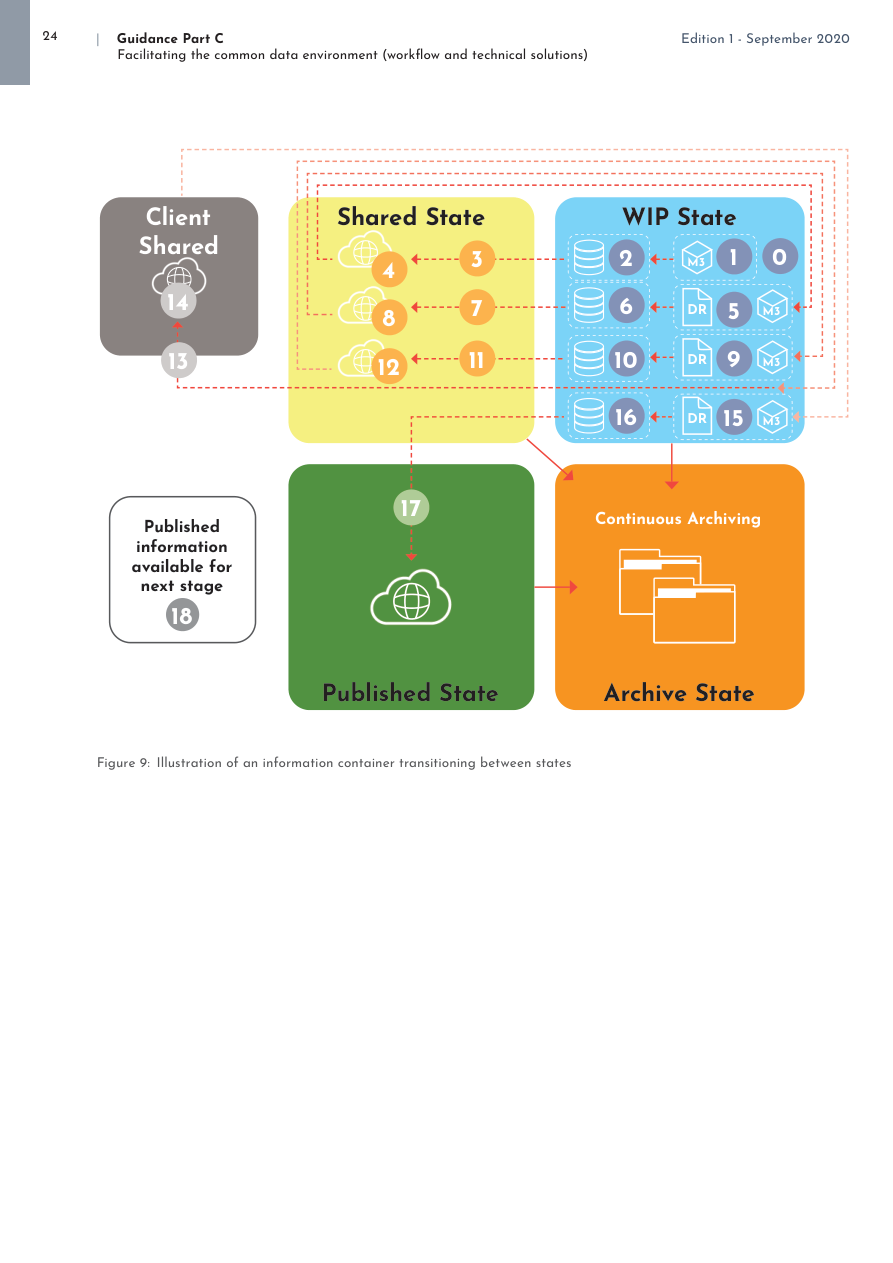
Figure 9 and Table 3 illustrate how status codes drive information container development and exchange as part of the CDE workflow in line with clause 5.6 and 5.7 of ISO 19650-2. This particular illustration relates to Stage 3 in the RIBA plan of work, and shows: • How the ISO 19650-2 clauses apply iteratively for each information container in reality • How information containers can cycle through the WIP and Shared states several times before they become Published • How the status code tells the recipient what action is required • How this task team, appointed at Stage 3, create their information in a geometrical model, which is coordinated with other geometrical models and/or their renditions (a rendition provides the underlying information in a particular form, in this case geometrical model content as a section, elevation or plan) • How the coordinated information is then exported from its native format as a drawing ready for comment • How, after comments are received, the native information must be updated as WIP before the drawing is reissued • How the authorization and acceptance of the reissued drawing must occur before it becomes Published information • For simplicity, Figure 9 indicates the progression of a drawing from its native geometrical model to authorization and acceptance. In reality, all of the information containers needed to satisfy the information exchange, as defined in the information exchange requirements, would move through a similar process (one such information container would be the geometrical model that has generated the drawing referred to).
24 | Guidance Part C Edition 1 - September 2020
Facilitating the common data environment (workflow and technical solutions) Client Shared State WIP State Shared 3 2 M3 1 0 4
14 DR 7 6 5 8 M3
DR M3 13 11 10 9 12
16 DR 15 M3
17 Continuous Archiving Published
information available for next stage Published State Archive State Figure 9: Illustration of an information container transitioning between states
25 | Guidance Part C Edition 1 - September 2020
Facilitating the common data environment (workflow and technical solutions) Table 3: Example of the iterative development of an information container ISO Step Details State Revision Status clause Collate and review all necessary information ready for start of 0 WIP - - 5.6.1 Stage 3. Information production commences, using other referenced sources for 1 WIP - - 5.6.2 coordination purposes. Several WIP iterations of a geometrical model by the author which are saved to a local CDE solution and assigned a metadata status S0.
2 The geometrical model undergoes a quality assurance check within the WIP P01.05 S0 5.6.3
task team to review the container (not its contents) against the project information standard. The contents of the geometrical model go through a final review within the task team. The geometrical model in its native or in an open format is assigned an S1 status, suitable for coordination only, 3 Shared P01 S1 5.6.4 and released for sharing. The task team has decided not to export documents/drawings from the geometrical model until the coordination review is complete. The geometrical model is shared via the CDE solution managed by the lead appointed party. The delivery team review the model alongside 4 Shared P01 S1 5.6.5 other information containers to “facilitate the continuous coordination of the information across each element of the information model”. Following the review, the authoring task team updates the geometrical model in the WIP state, based on feedback from the delivery team
5 following their coordination review. The geometrical model is also WIP P02.01 S0 5.6.2
refined and developed to allow a general arrangement drawing sheet to be exported. Drawing exported from geometrical design model. The revision and status columns now track the metadata of the drawing not the geometrical model. The geometrical model will, however, continue to be updated as part of the WIP steps below. The drawing is assigned a metadata status S0 and saved to a local
6 CDE solution with a metadata revision P01.01 until such time as it WIP P01.01 S0 5.6.3
passes its quality assurance checks within the task team. The contents of the drawing go through a final completeness and coherency review by the manager of the task team. The drawing is
7 assigned status S3, suitable for review and comment. As this drawing Shared P01 S3 5.6.4
is not being issued for coordination purposes but for comment, the drawing is shared directly with the lead appointed party. The drawing, along with any other supporting information, is reviewed by the lead appointed party to ensure it is compliant with project 8 Shared P01 S3 5.6.5 requirements. The lead appointed party comments and instructs the task team to update and reissue for authorization. Following the review, the authoring task team update the geometrical model in the WIP state based on the drawing comments from the lead 9 WIP P02.01 S0 5.6.2 appointed party. The drawing is re-exported. The drawing is assigned a metadata status S0 and saved to a local
10 CDE solution with a metadata revision P02.01 until it passes its quality WIP P02.01 S0 5.6.3
assurance checks within the task team. Table continues over page
26 | Guidance Part C Edition 1 - September 2020
Facilitating the common data environment (workflow and technical solutions) ISO Step Details State Revision Status clause The contents of the drawing go through a final completeness and coherency review by the manager of the task team. The drawing is 5.6.4 11 assigned an S6 status, suitable for Information model authorization Shared P02 S6 5.7.1 (PIM in relation to capital stage, refer to ISO definition). The drawing is shared directly with the lead appointed party The lead appointed party reviews the drawing along with any other information issued as part of the information model against the appointment requirements. The lead appointed party is satisfied and authorizes the task team to issue to the appointing party for acceptance. To save time, the lead appointed party may seek 12 Shared P02 S6 5.7.2 permission from the task team to issue directly to the appointing party on their behalf. This can be done so long as the permission is given and the CDE records and manages the process. This may remove the need for step 13 and would also remove the need for the S4 status in 14 Following authorization, the drawing requires no physical update so no WIP effort is required. The drawing is re-issued with status S4, noting the drawing meets the stage requirements and the task team Client 13 requests that it be accepted by the appointing party. If the physical P02 S4 5.7.3 Shared drawing came with the status metadata physically printed on the drawing, then a WIP effort would be required to amend the drawing contents to make this update. The appointing party reviews the drawing along with any other information issued as part of the information model against the Client 14 appointment requirement. The appointing party is satisfied and P02 S4 5.7.4 Shared accepts that the information meets stage requirements. The task team is permitted to publish the information container. Following appointing party acceptance, the authoring task team update the geometrical model in the WIP state to change the
15 preliminary revision to a contractual revision. The drawing is re- WIP P03.01 S0 5.6.2
exported and contains a physical contractual revision so the CDE solution used by the task team will record the drawing as P03.01. The drawing is assigned a metadata status S0 and saved to a local CDE solution with a metadata revision P03.01 until it passes its 16 WIP P03.01 S0 5.6.3 quality assurance checks within the task team to confirm that the contractual revision has been made correctly. The contents of the drawing go through a final completeness and coherency review by the manager of the task team. The drawing is then approved and the revision updated to reflect a contractual revision. The drawing is assigned status A3 denoting that it has 17 Published C01 A3 5.7.4 been authorized and accepted as suitable for stage 3 purposes and published onto the CDE for the project team to use. The appointing party will keep a record of this along with all other information that forms the completed stage 3 project information model. Published information from stage 3 is now available to be used during stage 4. This might be as reference information , if a new information container is being produced based on content in the 18 published information. Or it might be developed further itself, in which case the same container goes back to WIP state with the next sequential preliminary revision code and a status of S0. Although this process appears lengthy, it In reality, efficiencies can be found to illustrates the application of the ISO clauses streamline the process through intelligent use through iterative information container of the workflows that some CDE solutions development. provide.
27 | Guidance Part C Edition 1 - September 2020
Facilitating the common data environment (workflow and technical solutions)
6.4 Examples of status codes
Table 4 provides insight into when some of the Note 2, the codes can be expanded (or by status codes maybe used in certain situations. the same principle, excluded) to suit specific These codes are referenced in the National project requirements providing the required
Annex (ISO 19650-2 Table NA.1). codes are documented in the project’s
As stated in ISO 19650-2 clause NA.4.2 information standard and agreed. Table 4: Application of status codes Assigned by task teams to identify information containers as Work in Progress and not yet suitable to S0 be Shared outside the task team. Assigned by task teams to limit the information container’s use to coordination activities only by its recipients. Information containers assigned this status should only be used to understand or S1 advance their own deliverables in a coordinated manner. It is likely to be assigned to a geometrical information container but it is important to understand that S1 can be assigned to any information container. Assigned by task teams to limit the information containers use for any specific activity by its recipients. This status denotes that the author is providing it for information only to help others S2 in certain situations. For example, reference information provided by the appointing party such as a dilapidations report would be given this status code. Another example would be an email file containing site photos. Assigned by task teams to limit the information containers use to commenting and review activities only by its recipients. Information containers assigned this status should only be used to review their S3 contents against the information requirements or to provide feedback on their development. For example, an outline proposal to solve a technical design problem during Concept stage. Assigned by task teams to limit the information containers use to stage approval activities only S4 by its recipients. The outcome of the review following this status should be the acceptance of the information container that it meets stage requirements. S5 This status code is not used in the National Annex Assigned by task teams to limit the information containers use to the lead appointed party’s authorization of the project information model (see ISO 19650-2 clauses 5.7.1 and 5.7.2). The information should not be used for contractual purposes, for example, construction until the project information model that it forms part of has been authorized by the lead appointed party and accepted by the appointing party. If the project information model is rejected but the information S6 container itself does not require amendment its status will remain at S6 until the project information model is authorized. If the project information model is rejected and the information container requires amendment then it is assigned the S0 status until it can be shared again. Note that a project information model could be a single information container or it could be multiple information containers depending on the exchange information requirements. Assigned by task teams to limit the information container`s use to authorization activities for Stage
6 (Handover) only by its recipients. The outcome of this status should be the authorization of the S7 information model that it meets the requirements for handover to facilities and asset management
teams. Assigned by task teams to represent the Stage the authorized and accepted information container A0 relates to in accordance with the task information delivery plan. For example A1 would represent an - authorized and accepted information container generated in Stage 1, A2 would represent Stage 2 An and so on Assigned by task teams to represent an information container that has been authorized and CR accepted and was previously assigned an S7 status.
28 | Guidance Part C Edition 1 - September 2020
Facilitating the common data environment (workflow and technical solutions)
7.0 Checklist of actions/key points to
consider ISO 19650-2 clause references are shown in b) ensuring there is an audit trail of brackets. updates to the native information container and its exported information
9 Has any project-specific expansion of the containers.
standard status codes and revision system been defined in the project’s information 9 Have all the potential CDE solutions been standard by the appointing party (5.1.4) reviewed to ensure they support the agreed and has that been reviewed or amended metadata assignment (5.1.5, 5.5.2)? (and agreed with the appointing party) to suit delivery requirements by each lead 9 Have security considerations been appointed party (5.3.2, 5.4.1)? considered when selecting the potential CDE solution(s) to ensure that access
9 Has a classification system been defined permissions can be set at an individual and
in the project’s information standard by organizational level (5.1.5, 5.3.2, 5.5.2)? the appointing party (5.1.4) and has that been reviewed or amended (and agreed 9 If multiple CDE solutions are being used with the appointing party) to suit delivery to implement the CDE workflow, some requirements by the lead appointed party of which maybe owned or managed (5.3.2, 5.4.1)? by different organizations, has the CDE workflow been reviewed to ensure
9 Has an information container ID information containers pass seamlessly
codification standard been defined in through each CDE solution (5.5.2)? the project information standard by the appointing party (5.1.4) and has that 9 Have the CDE solutions been tested to been reviewed or amended (and agreed ensure metadata assignments can be with the appointing party) to suit delivery transferred between them? requirements by the lead appointed party 9 Has it been agreed how information (5.3.2, 5.4.1)? containers will be transferred between solutions manually or automatically? 9 Does the codification standard define how model renditions/exports are to be 9 Has a clear CDE workflow been given different container names? For implemented and documented for how example, IFC step files should be named each type of information container will be differently from their native source developed> checked> shared> authorized> geometrical models and PDF files should accepted> published> archived? be named differently from their native (associated with Clause 5.5.2) 2D drawing equivalents (so that no two containers have the same ID). Note that each time the native information container is updated, associated exports should also be updated (as far as they are impacted by the update of the native information container). This requires the author of the information container to pay careful attention to
- a) exporting associated updates and
29 | Guidance Part C Edition 1 - September 2020
Facilitating the common data environment (workflow and technical solutions)
9 Has the project got a clear documented set
of standard methods and procedures for how metadata assignments defined in the information standard shall will be assigned to the information containers (Clause 5.5.3)?
9 Has it been confirmed which tables/
sets of the classification system shall be applied to which types of information/ information container?
9 Has it been confirmed what each status
code means and its constraints for use?
9 Has it been confirmed how new project
specific codes will be generated, agreed and documented?
9 Has it been made clear how each
metadata assignment is made in (each of) the CDE solution(s)
30 | Guidance Part C Edition 1 - September 2020
Facilitating the common data environment (workflow and technical solutions)
8.0 Summary
ISO 19650 guidance C has provided further insight into facilitation of the common data environment. It should be referred to by practitioners and those implementing the ISO 19650 series across a project, within an appointment or within an organization. Please note that the ISO 19650 series is still new, albeit based on former UK standards. As experience of implementing the ISO 19650 series is gained over the coming months and years, this guidance will be updated to reflect both this experience and any comments/ feedback received from users. Please do let us have your feedback by emailing us at guidancefeedback@ukbimframework.org . Please also remember that standards within the ISO 19650 series are available at www.bsigroup.com. Visit www.ukbimframework.org to see how the ISO 19650 standards plus other standards within the UK BIM Framework map to the design, build, operate and integrate process.
info@ukbimframework.org @UKBIMFramework https://ukbimframework.org/ UKBIMFramework The Centre for Digital Built Britain is part of the Construction Innovation Hub programme, funded by UK Research and Innovation through the Industrial Strategy Challenge Fund.