
ISO 19650 Guidance 4: Information exchange
Introduction
This guidance introduces BS EN ISO 19650-4 (hereinafter referred to as ISO 19650-4) and its role in supporting information management and delivery. It does not change the meaning of the standard, which should be read alongside.
1.0 Context
ISO 19650-4 was proposed in 2018 and published in Autumn 2022. Given the breadth of scope of ISO 19650 Parts 1, 2, 3 and 5, it was agreed that it was necessary to reinforce the information requirements and common data environment (CDE) process with more substantive attention to the criteria applicable to any information exchange. ISO 19650-4 establishes a specification for information quality and sustainability that is applicable to all exchanges. This allows appointing parties such as clients and facility operators as well as other information customers to focus on their own specific needs. ISO 19650-4 is part of the UK BIM Framework and part of the UK Government Information Management Mandate. It is relevant to anyone generating or receiving information. In the standard the word ‘shall’ emphasises a requirement, whereas ‘shall consider’ leaves some flexibility as to the manner in which the requirements are achieved. In the National Annex, ‘should’ indicates a strong recommendation on how to implement aspects of the standard.
2.0 What does ISO 19650 Part 4 do?
The ISO 19650 series already offers a quality process for the procurement of asset information which runs alongside the procurement of project and in-use services. ISO 19650-1 identifies the key tools and methods to be used. Part 2 and Part 3 define how these methods can be applied. Part 5 adds consideration of the security of built assets and their virtual counter-parts. ISO 19650-4 re-enforces the CDE process as a means to ensure the quality of the exchanged information. It sets out the criteria for adopting specific technologies and standards during the information procurement process and then sets the common (but often neglected) criteria that should be applied to each individual information exchange.
3.0 What are the benefits?
If followed properly, the CDE process can be considered as a mechanism to ensure respect and trust between the multiple parties involved. ISO 19650-4 considers how the same mechanism can ensure respect and trust in each information delivery, and so contribute to the quality of the overall project/asset information model. There are many benefits arising from having a respectable and trustworthy information model as against an unmanaged information model. These include: Better design and planning outcomes Better on-site outcomes Better readiness for the next project stage or in-use events. Better preparedness for the sustained use of a built asset over its whole life. These improvements will benefit the immediate participants in the built asset process and also the future participants. What's in it for clients and owners/operators ? Whilst the general benefits above accrue to many stakeholders, the benefit to clients and owners/operators can be seen in considering some of the challenges they face in developing and managing built assets: how can they meet decarbonisation targets, demonstrate safety, report on environmental, social and governance issues (ESG), or understand supply chain fragilities without trustworthy information?
4.0 What do the parties do?
ISO 19650 Parts 1, 2, 3 and 5 use the terms appointing, lead appointed and appointed parties. When considering a specific information exchange, these parties will take differing roles as the CDE process progresses. To support this, ISO 19650-4 uses the terms information provider, receiver, and reviewer. It considers how these activities are carried out at the two key decision points for an information exchange in the CDE process, as shown in Figure 1 and Table 1. The criteria for decision making at both these two decision points are the same: the fulfillment of the applicable exchange information requirements - EIR (and any supporting standards and methods and procedures) and the criteria in ISO 19650-4 clause 7, covering information quality. The review should also cover technical quality. ISO 19650 Guidance 4: Information exchange 2
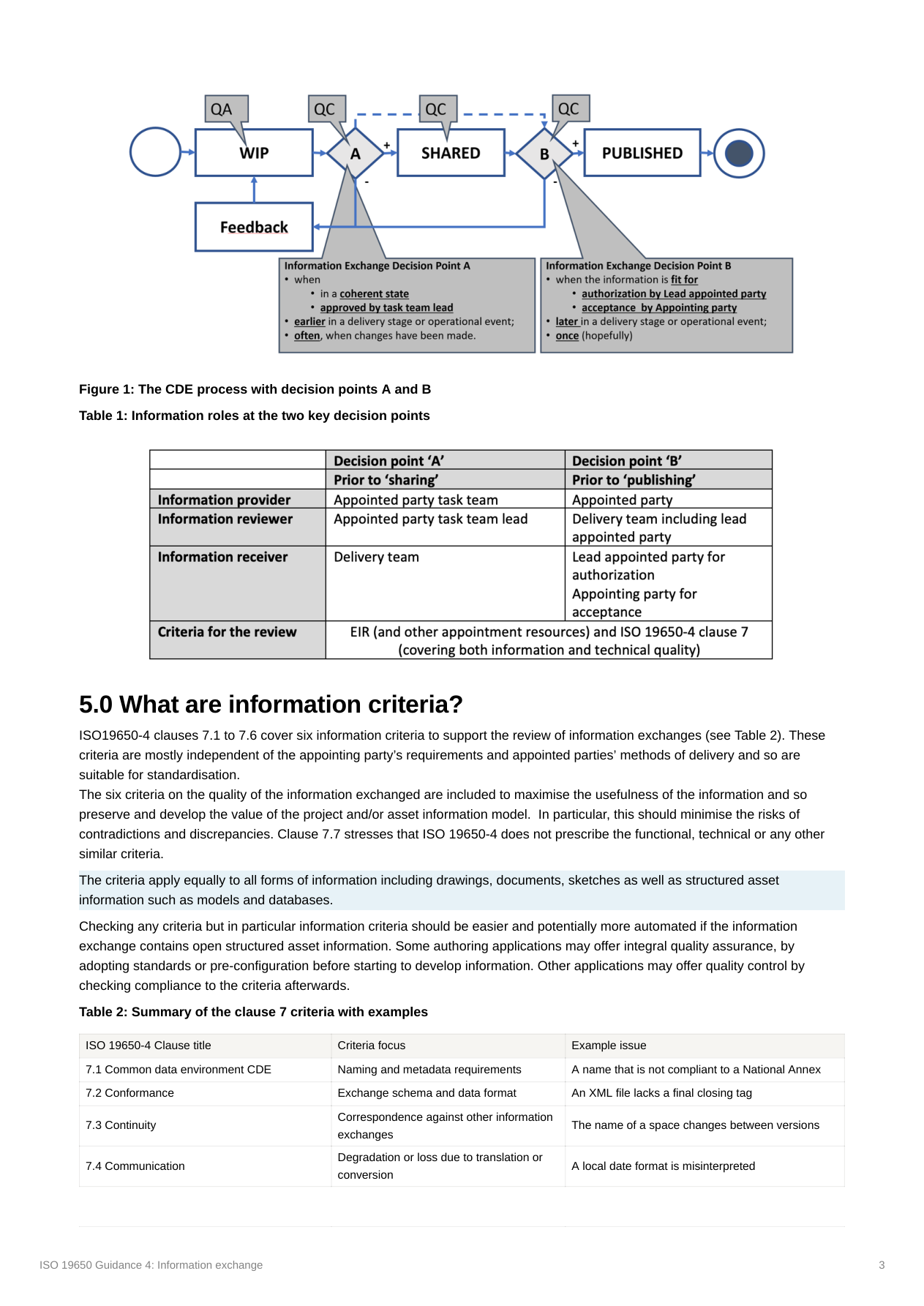
Figure 1: The CDE process with decision points A and B Table 1: Information roles at the two key decision points
5.0 What are information criteria?
ISO19650-4 clauses 7.1 to 7.6 cover six information criteria to support the review of information exchanges (see Table 2). These criteria are mostly independent of the appointing party’s requirements and appointed parties’ methods of delivery and so are suitable for standardisation. The six criteria on the quality of the information exchanged are included to maximise the usefulness of the information and so preserve and develop the value of the project and/or asset information model. In particular, this should minimise the risks of contradictions and discrepancies. Clause 7.7 stresses that ISO 19650-4 does not prescribe the functional, technical or any other similar criteria. The criteria apply equally to all forms of information including drawings, documents, sketches as well as structured asset information such as models and databases. Checking any criteria but in particular information criteria should be easier and potentially more automated if the information exchange contains open structured asset information. Some authoring applications may offer integral quality assurance, by adopting standards or pre-configuration before starting to develop information. Other applications may offer quality control by checking compliance to the criteria afterwards. Table 2: Summary of the clause 7 criteria with examples ISO 19650-4 Clause title Criteria focus Example issue
7.1 Common data environment CDE Naming and metadata requirements A name that is not compliant to a National Annex
7.2 Conformance Exchange schema and data format An XML file lacks a final closing tag
Correspondence against other information
7.3 Continuity The name of a space changes between versions
exchanges Degradation or loss due to translation or
7.4 Communication A local date format is misinterpreted
conversion ISO 19650 Guidance 4: Information exchange 3
ISO 19650-4 Clause title Criteria focus Example issue An entity occurs in two federated models Two wall Federation, spatial and attribute entities overlap or have a gap The weight on an
7.5 Consistency
consistency equipment occurrence differs from the product description The presence and adequacy of the Material and volume values are missing from a bulk
7.6 Completeness
information element
6.0 What does information sustainability mean?
ISO 19650-4 has at its heart the need for a sustainable approach to information. Sustainable information is information that exists, and continues to exist, outside of any authoring or consuming applications. The value of an information model is based on meeting the immediate appointment terms, and extends into supporting the next project stages and in-use events. The same information may have a critical role in supporting decisions about economic, environmental and social sustainability in the future. This means that it is crucial that information is asked for and prepared without compromising its use in the future. Therefore ISO 19650-4 encourages the use of open standards. The informative Annexes list candidate open standards for the structure, format and classification of information.
7.0 Does this change or clarify CDE usage?
The operation of a CDE is discussed in ISO 19650 Guidance C: Facilitating the CDE (workflow and technical solutions). ISO 19650-4 puts particular emphasis on the behaviour that maximizes the value of the CDE. This includes ‘sharing’ early and often when information is being developed, and later ‘publishing’ once (hopefully), when authorized and accepted.
8.0 What does the UK National Annex do?
The UK National Annex published as part of BSI EN ISO19650-4 provides additional criteria that are specific to UK practice. The most important of these is the application of the Uniclass classification system both to each information container and to the entities described within the information container, such as Zones and Products. The National Annex contains a full list of entities with examples.
9.0 Summary
This guidance has addressed major aspects of the practical application of ISO 19650-4 and its UK National Annex. Some key points are: Do you have processes in place to check the six criteria? Are you using Uniclass appropriately? Have you considered the medium and long-term use of the information? Does your implementation of ISO 19650 series promote trustworthiness between participants and trustworthiness of the resulting information model? Nothing in this guidance constitutes legal advice or gives rise to a solicitor/client relationship. Specialist legal advice should be taken in relation to specific circumstances. The contents of this guidance are for general information purposes only. Permission to reproduce extracts from the ISO 19650 series is granted by BSI Standards Limited (BSI). No other use of this material is permitted. British Standards can be obtained in PDF or hard copy formats from the BSI online shop: http://www.bsigroup.com/Shop or by contacting BSI Customer Services for hard copies only: Tel: +44 (0)20 8996 9001, Email: cservices@bsigroup.com Any data or analysis from this guidance must be reported accurately and not used in a misleading context. If using any information from this report, then its source and date of publication must be acknowledged. ISO 19650 Guidance 4: Information exchange 4
© COPYRIGHT 2023 the Editors, Authors and Contributors named in the Acknowledgements. Rrd01UVTROeUlzSW5kdmNtdHpjR0ZqWlZSeVlXTnJaWEpKWkNJNkltMU1ha0ZXVWtGd04zZE5iemhzTjBoMk1IRXpJbjA9 ISO 19650 Guidance 4: Information exchange 5